
Occupational therapists often work with people during vulnerable moments in their life.
They may help someone recover from an injury or an illness while learning new ways to participate in school, work, home, and community life. But having a desire to help people is only one aspect of becoming an OT. Understanding whether occupational therapy is right for you means assessing your skills, career goals, and the type of work you’re comfortable doing.
OT may be a strong fit if you enjoy working directly with people, thinking creatively, applying science to practical challenges, and helping clients build or regain independence. It may not be the right fit if you are looking for a predictable desk-based career, want to avoid hands-on clinical work, or are uncomfortable with documentation, collaboration, physical demands, or emotionally complex client situations.
So, should you become an occupational therapist? The answer depends on whether you want a healthcare career centered on daily function, hands-on problem-solving, and helping people tackle a multitude of challenges.
Key Takeaways
- Occupational therapy may be a good fit if you want a healthcare career focused on helping people participate more fully in daily life.
- Strong OTs combine empathy and communication with clinical reasoning, problem-solving, adaptability, and hands-on skills.
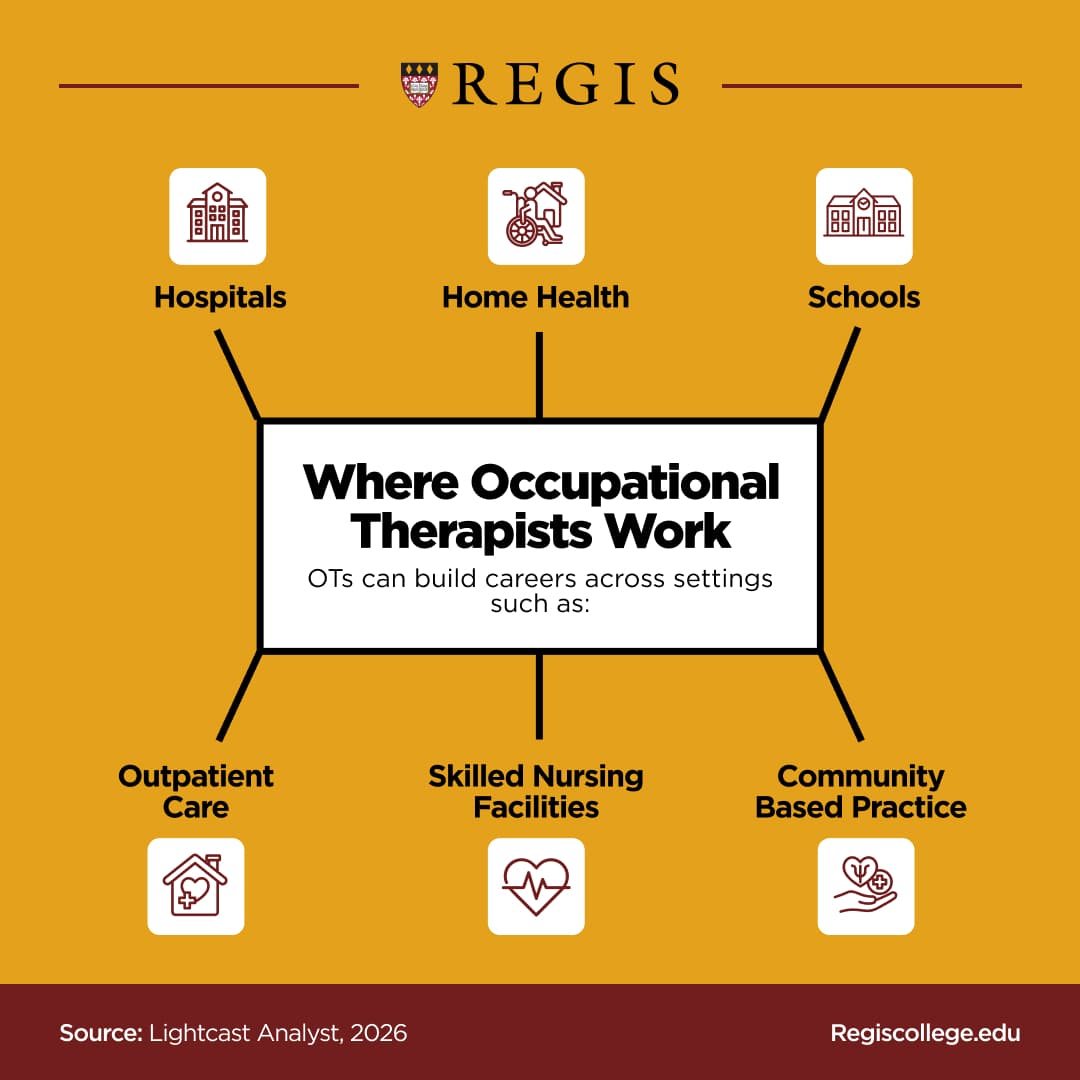
- The field offers flexibility across settings such as hospitals, schools, outpatient clinics, home health, nursing care facilities, and community-based practice.
- Prospective students should consider the demands of graduate education, fieldwork, certification, licensure, documentation, and client care.
- Regis College’s Master of Science in Occupational Therapy helps students prepare through active-practitioner faculty, close-knit classes, hands-on learning, service learning, and fieldwork-rich clinical preparation.
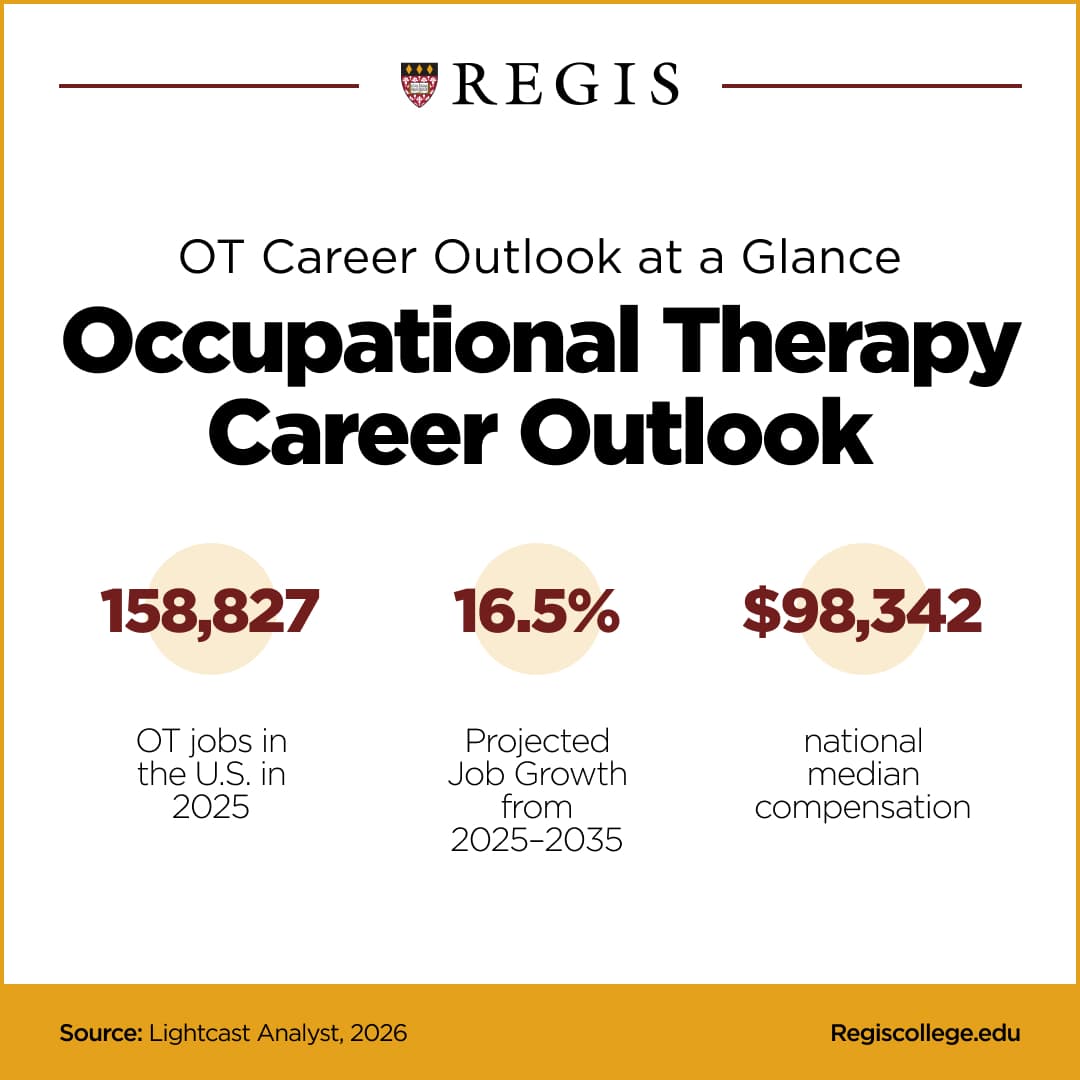
What Does an Occupational Therapist Actually Do?
Occupational therapists help people develop, recover, improve, or maintain the skills needed for daily living and working. They evaluate and treat people with injuries, illnesses, or disabilities to help them with daily living, vocational, and other skills that promote independence.
That work can look different depending on an occupational therapist’s client and where they work. An OT might help:
- A person recovering from a stroke relearn how to get dressed
- A child participates more fully in school activities
- An older adult adapt their home to reduce fall risk
- A client with a permanent disability use adaptive equipment
- A patient recovering from injury regain strength, coordination, or independence
- A person in a mental health setting build routines and skills for daily life
OTs are often asked to develop treatment plans, recommend adaptive equipment, educate families and caregivers on how to support the client’s progress, document progress, and collaborate with other healthcare or education professionals.
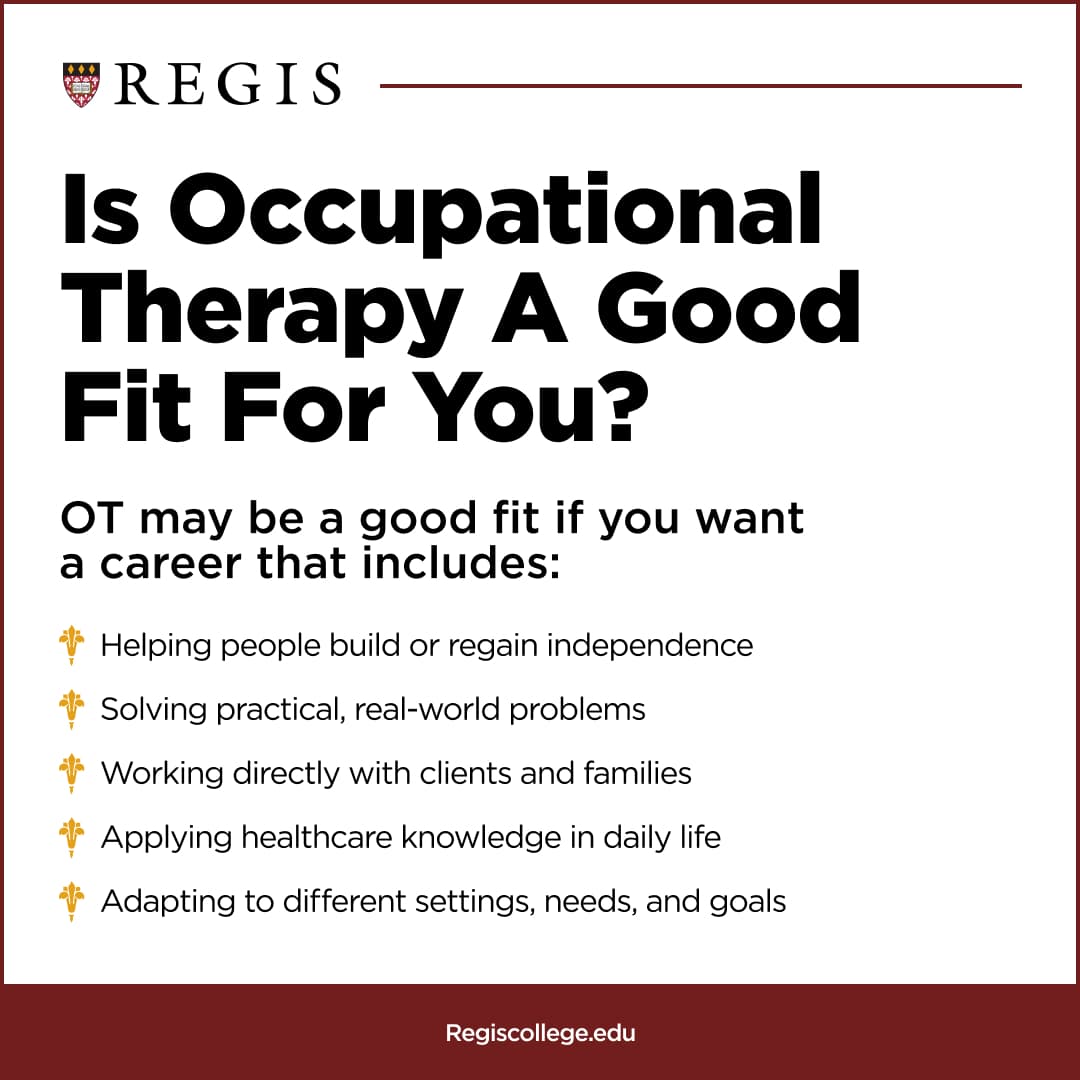
Signs Occupational Therapy May Be a Good Fit for You
No single personality type makes a good occupational therapist. The field includes people with many different strengths and interests. Still, there are signs that OT may fit what you’re looking for in a career.
You are Drawn to Work Centered on Helping People Regain Independence
Occupational therapy is built on the principle that daily activities matter. OTs help people do the things they need and want to do, whether that means returning to work, participating in school, caring for family, managing a home, or engaging in meaningful routines.
The focus is not only on treating a condition. It is on helping a person participate more fully in life.
Mary Elizabeth Patnaude, associate professor and MSOT program director at Regis College, connects this service orientation to the values of the profession.
“We really focus on helping others,” Patnaude says. “That’s kind of what OTs do. We really advocate for people and advocate for our patients, and I feel like the mission of (Regis College) is really closely aligned with the mission of our profession.”
If you are motivated by independence, dignity, quality of life, and practical problem-solving, OT may be a natural fit.
Wondering If Occupational Therapy Is Right For You?
Download our free guide to gain insights about the career!

You Enjoy Solving Practical, Real-World Problems
Occupational therapists are, by nature, problem-solvers.
As an example, a client may be physically able to move but unable to safely navigate their home, or a child may understand schoolwork but struggle with the motor, sensory, or self-regulation skills needed to participate in class. In each case, the OT has to evaluate the situation, understand the person’s goals, and develop a practical plan.
This requires OTs to devise solutions that work in real homes, schools, hospitals, workplaces, and communities.
Students who enjoy asking “What is getting in the way?” and “How can we adapt this?” may find OT especially rewarding.
You are Interested in Healthcare, but Want a Broad View of the Person
Many healthcare professionals focus on diagnosis, medication, procedures, or acute medical needs. Occupational therapy requires a broader view.
OTs consider physical, cognitive, emotional, social, environmental, and occupational factors. They ask how an illness, injury, disability, or developmental need affects a person’s ability to function in the way they desire.
Considering the well-being of the whole person can be especially appealing to students who are interested in disciplines such as psychology, human development, education, rehabilitation, disability advocacy, movement, and behavior. This is one reason OT can lead to many settings and specialties.
You Like Working Directly with People
Occupational therapy is a people-centered profession. OTs interact with clients, families, caregivers, teachers, and other professionals.
Understanding how to communicate, show compassion as well as patience, and be adaptable to changing realities is essential for OTs to be successful. Clients may be frustrated, tired, overwhelmed, discouraged, or anxious. Families may need education and support. Other providers may need clear updates and collaboration.
That doesn’t mean every successful OT is a natural extrovert. But they should have the skills that allow them to communicate clearly, listen carefully, build rapport, and adjust their approach to different people.
You Can be Patient with Gradual Progress
In occupational therapy, progress can be slow and steady.
A client may need repeated practice to relearn a daily task. A patient recovering from injury may have good days and difficult days. An older adult may need encouragement as they adapt to new routines or equipment.
OTs need to understand that progress often occurs in small steps forward and find a way to celebrate those steps, even when the progress looks modest from the outside.
Part of what makes occupational therapy meaningful is helping a client make small but meaningful steps forward—buttoning a shirt, returning to a classroom activity, preparing a meal, or safely moving through their home.
You are Comfortable Thinking on Your Feet
Occupational therapy rarely follows a script. A client’s needs may change from one session to the next. A treatment plan may need to be adjusted. A family may raise new concerns. A hospital or school caseload may require quick transitions between clients.
Patnaude says this flexibility is especially important for new practitioners.
“You’re going to be busy,” she says. “Everybody who works in the medical field nowadays, it’s a very complex environment no matter what system you’re in, and you have to be able to hit the ground running and be professional and ask people questions... You have to be able to handle a lot because there’s no place you’re going to work where you’re not going to have a heavy caseload.”
For many people, that active work environment is part of the appeal. OT work is varied, responsive, and connected to real human needs. No day will look exactly like the other.
You Want a Career with Multiple Possible Settings and Specialties
Occupational therapists can work in many settings and with many types of clients. Professionals work across healthcare, education, local communities, and rehabilitation settings.
The Bureau of Labor Statistics lists hospitals, offices of physical, occupational, and speech therapists, educational services, home healthcare, and nursing care facilities as some of the most common professional settings for occupational therapists.
That range can be very appealing to those who want a career that provides room to grow. Over time, occupational therapists may pursue areas such as pediatrics, school-based practice, hand therapy, older-adult care, mental health, rehabilitation, home health, assistive technology, or community-based practice.
Strong MSOT programs expose students to that range of settings and populations. At Regis, fieldwork opportunities include hospitals, school systems, outpatient practices, community-based mental health, adapted sports, and other OT practice environments.
Things to Consider Before Becoming an Occupational Therapist
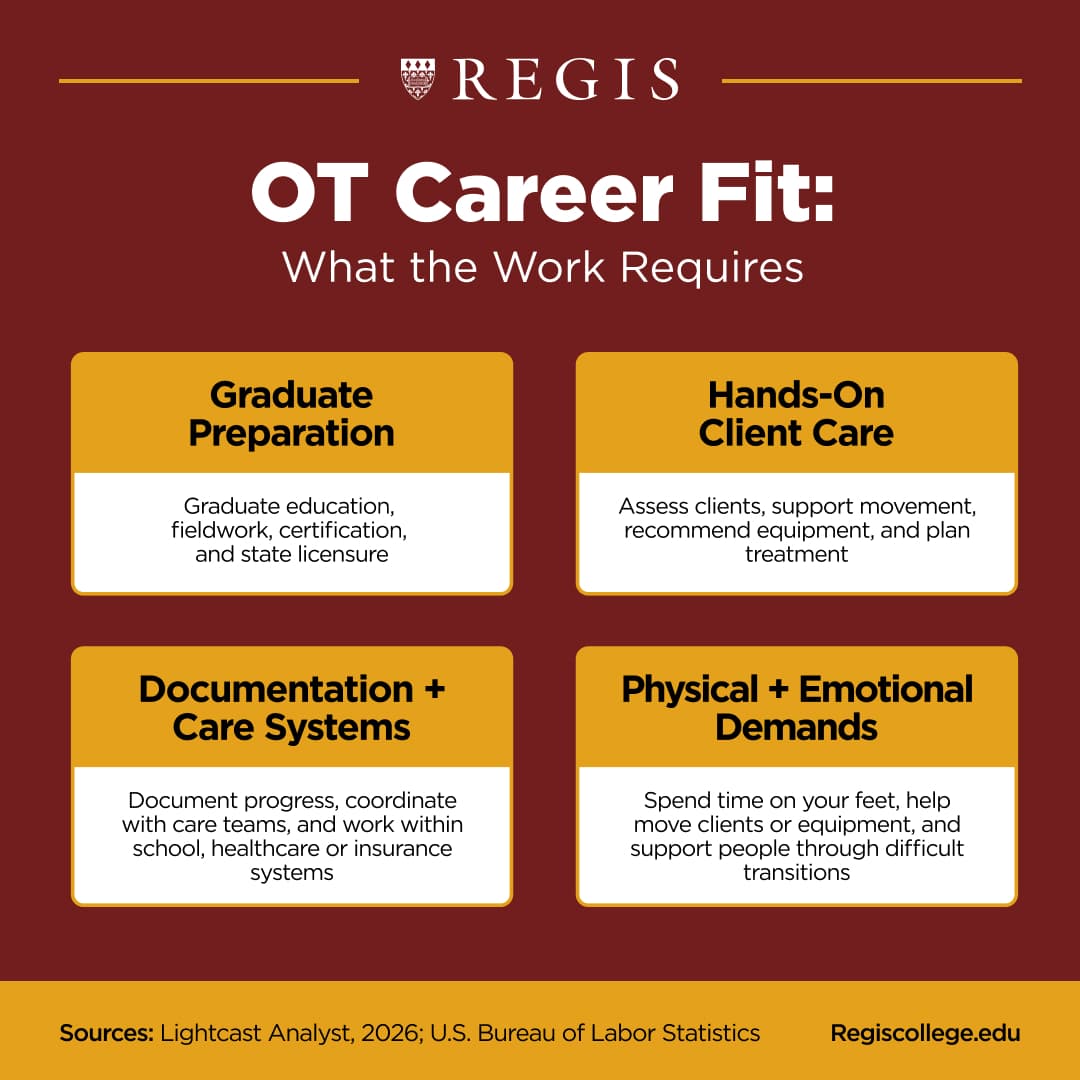
A career in occupational therapy can be deeply fulfilling, but it is also demanding. Before committing to the field, prospective students should understand what the path requires.
OT Requires Graduate Education, Certification, and Licensure
Occupational therapists typically need a graduate degree in occupational therapy, either a master’s or doctoral degree.
The National Board for Certification in Occupational Therapy states that U.S.-educated occupational therapist registered (OTR) candidates must graduate with an entry-level occupational therapy degree from an ACOTE-accredited OT program to be eligible for the NBCOT exam.
All states require occupational therapists to be licensed, though specific requirements vary by state.
The Work Can be Physically and Emotionally Demanding
OTs may spend a lot of time on their feet and may need to lift or move clients or equipment. Occupational therapists may also be required to work nights or weekends as needed to accommodate clients’ schedules.
The emotional side of the profession matters as well. OTs often work with people who are adjusting to pain, disability, illness, developmental challenges, trauma, or loss of independence. That can be difficult, but it can also be one of the reasons the career feels meaningful.
Future OTs should be prepared for both parts of the profession: the satisfaction of helping people make progress and the reality that progress can require patience, emotional resilience, and professionalism.
Documentation and Systems are Part of the Job
The daily work of an occupational therapist does not end when a treatment session ends. Documentation is part of professional practice.
OTs may need to record client progress, update care plans, communicate with other providers, and document services for billing, school, insurance, or regulatory purposes. Patnaude notes that OT students also need to learn about “being ethical and dealing with the insurance companies” as part of professional preparation.
That administrative side of the job may not be the first thing students think about when they picture OT. But it’s an integral part of how therapists communicate care, support continuity, and advocate for client needs within larger systems.
You Need to be Comfortable Learning Hands-On Clinical Skills
Occupational therapists need to be encouraging and skilled communicators. But they also require clinical preparation.
“It’s the hands-on clinical skills (that are essential),” Patnaude says. That’s why, for the Regis program, there’s an emphasis on “getting hands-on practice—how to transfer patients, how to assess patients, writing treatment plans for patients—and we have practice classes starting the first semester.”
Students learn how to assess clients, support movement, develop treatment plans, practice therapeutic interventions, understand safety, recommend adaptive equipment, and apply knowledge from anatomy, kinesiology, neuroscience, psychology, and other areas.
That is why it is important to choose a graduate program that emphasizes applied learning, fieldwork, and clinical reasoning—not only classroom theory.
How Regis Helps Students Prepare for an OT Career
For students who see themselves in occupational therapy, the next question is how to prepare for the profession. Regis College’s MSOT program is designed for students who want a clinically focused path into OT practice.
Regis helps students build career readiness through:
Active-Practitioner Faculty
Regis’ OT faculty are active practitioners who bring current, real-world experience into the classroom. That helps students connect theory with actual practice.
Fieldwork-Rich Preparation
Students learn through classroom, service learning, and fieldwork experiences. Regis’ program offers fieldwork opportunities in a wide range of settings, from large hospitals and school systems to outpatient practices, community-based mental health, adapted sports, and other nontraditional sites.
Close-Knit Classes
Regis emphasizes close-knit classes and personalized attention, which can be especially valuable in a hands-on clinical field where students are learning to build confidence, ask questions, and apply feedback.
Clinical Focus
Patnaude describes Regis as a program for students who want a practical, clinician-focused graduate experience.
“We’re going to help people who want to become clinicians and who want to have a two-year program, get in and out quickly, and be ready to work,” she says.
That clinical focus also shapes the structure of the curriculum—students can complete the MS degree in 24 to 30 months, depending on the entry point. Students weighing that commitment may also want to consider the timeline for completing an MSOT alongside the cost of earning a master’s in occupational therapy.
Should You Become an Occupational Therapist?
You should consider becoming an occupational therapist if you want a career that combines healthcare knowledge, hands-on practice, problem-solving, creativity, advocacy, and meaningful client relationships.
OT may be a strong fit if you are drawn to helping people regain independence and participate more fully in daily life. It may also be a good fit if you want a career with multiple practice settings, opportunities to work with different populations, and a balance of science and human-centered care.
At the same time, occupational therapy requires preparation. Future OTs should be ready for graduate education, fieldwork, certification, licensure, documentation, collaboration, and the physical and emotional demands of client care.
For students who are ready for that path, Regis College’s Master of Science in Occupational Therapy offers a clinically focused graduate experience with active-practitioner faculty, hands-on learning, close-knit classes, service learning, and fieldwork opportunities near Boston.
To learn more, explore Regis’ MSOT program, request information, or sign up for an information session.



Published Date