
Future occupational therapists often find themselves comparing two paths: a master’s vs. doctorate in occupational therapy.
That comparison often leads to practical questions: Is the doctorate replacing the master’s? Will an OTD make me more competitive? Is an MSOT still enough if my goal is to become a practicing occupational therapist?
The short answer: You do not need an OTD to become an occupational therapist. According to the
Key Takeaways
- You do not need an OTD to become an occupational therapist; both accredited master’s and doctoral programs can prepare students to pursue certification and licensure.
- An MSOT is often the better fit for students who want a direct, clinically focused path into occupational therapy practice.
- An OTD may be a stronger choice for students interested in doctoral-level preparation, research, teaching, leadership, policy, advocacy, or program development.
- Fieldwork quality matters as much as degree title because it helps students build the clinical reasoning, confidence, and hands-on skills needed for practice.
- Regis College’s Master of Science in Occupational Therapy offers a close-knit, clinically focused graduate experience with active-practitioner faculty and access to fieldwork opportunities near Boston.
What’s the Difference Between an MSOT and an OTD?
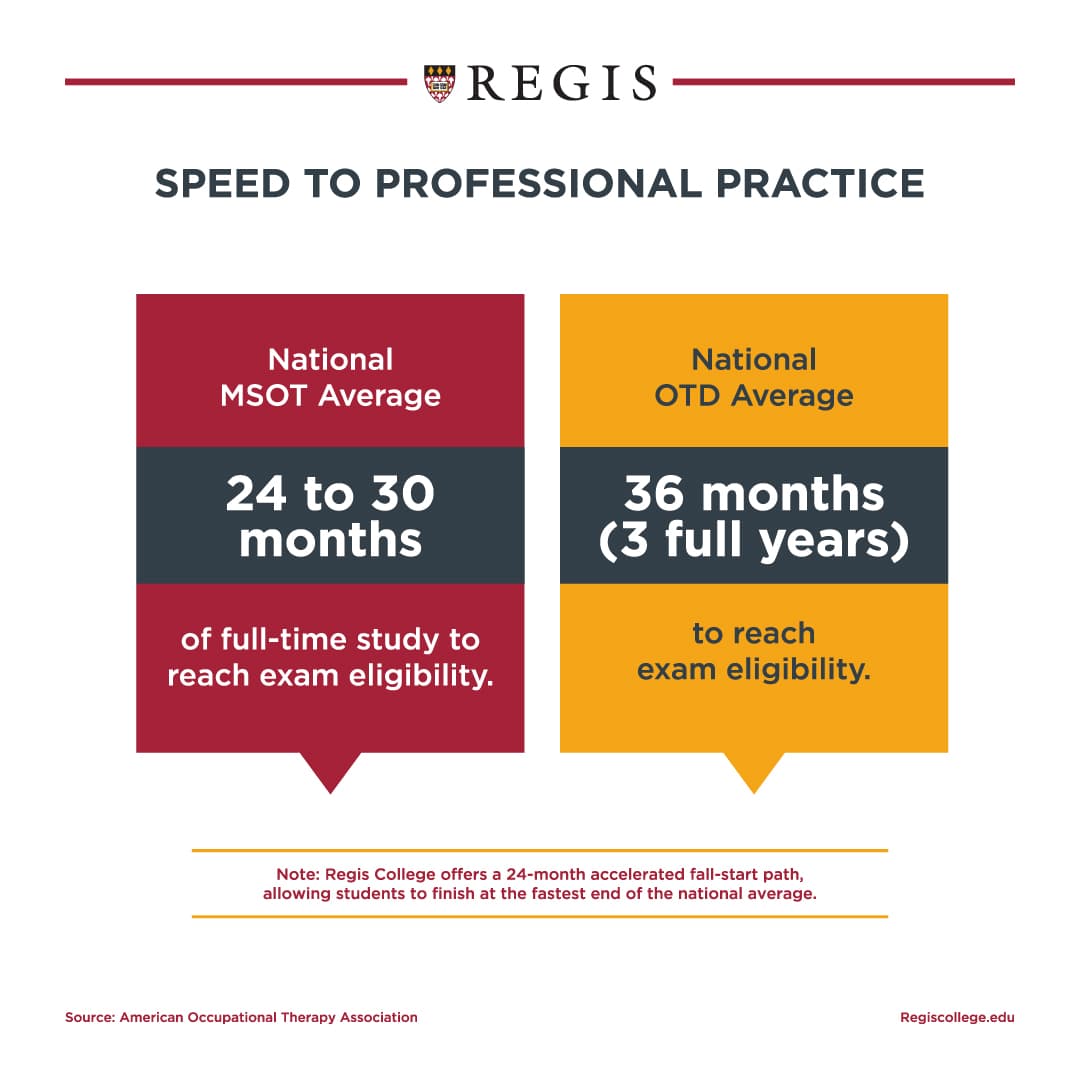
A master of science in occupational therapy prepares students for entry-level occupational therapy practice through graduate coursework, lab-based learning, fieldwork, and preparation for the national certification exam. At Regis College, for instance, the MSOT program is designed to be an immersive, full-time program that can be completed in 24 to 30 months, depending on whether students begin in the fall or spring.
An entry-level OTD also prepares students for the OT profession, but it includes doctoral-level work beyond the requirements of a master’s program, providing more in-depth preparation in areas such as clinical practice skills, research, administration, leadership, policy and program development, advocacy, education, and theory. OTD students also complete a doctoral capstone experience and culminating project.
In short, both degrees can lead to OT practice, but the OTD adds doctoral-level coursework and a capstone.
Wondering If Occupational Therapy Is Right For You?
Download our free guide to gain insights about the career!

Can You Become an Occupational Therapist With an MSOT?
Yes. To become an occupational therapist in the United States, you must complete an accredited occupational therapy program, meet fieldwork requirements, pass the National Board for Certification in Occupational Therapy exam, and satisfy state licensure requirements.
NBCOT states that U.S.-educated OTR candidates must graduate with an entry-level occupational therapy degree from an ACOTE-accredited occupational therapy program. AOTA also notes that occupational therapy practitioners must pass the NBCOT exam to practice in the United States, and that state licensure requirements vary by state.
When an MSOT May Be the Better Fit
An MSOT may be the right choice if your main goal is to become a practicing clinician.
Many students enter occupational therapy because they want to work directly with clients. That might mean helping:
- A child participate more fully at school
- An older adult regain independence after a stroke
- A patient adapt daily routines after an injury
- A person with a disability navigate home, work, or community life with greater confidence
- A client use adaptive equipment or therapeutic strategies to complete meaningful daily activities
Mary Elizabeth Patnaude, Associate Professor and MSOT Program Director at Regis College, says this distinction is important for students who are trying to decide how much graduate education they really need before entering practice.
“You do not need a doctorate to practice,” Patnaude says. “There’s a lot of opportunity for specialty certifications if you’re a clinician.”
That doesn’t mean an OTD is the wrong choice. Students should be clear about what they want the degree to do for them. If the goal is to become a practicing occupational therapist, begin building clinical skills, and enter the workforce sooner, an MSOT may offer the more direct route.
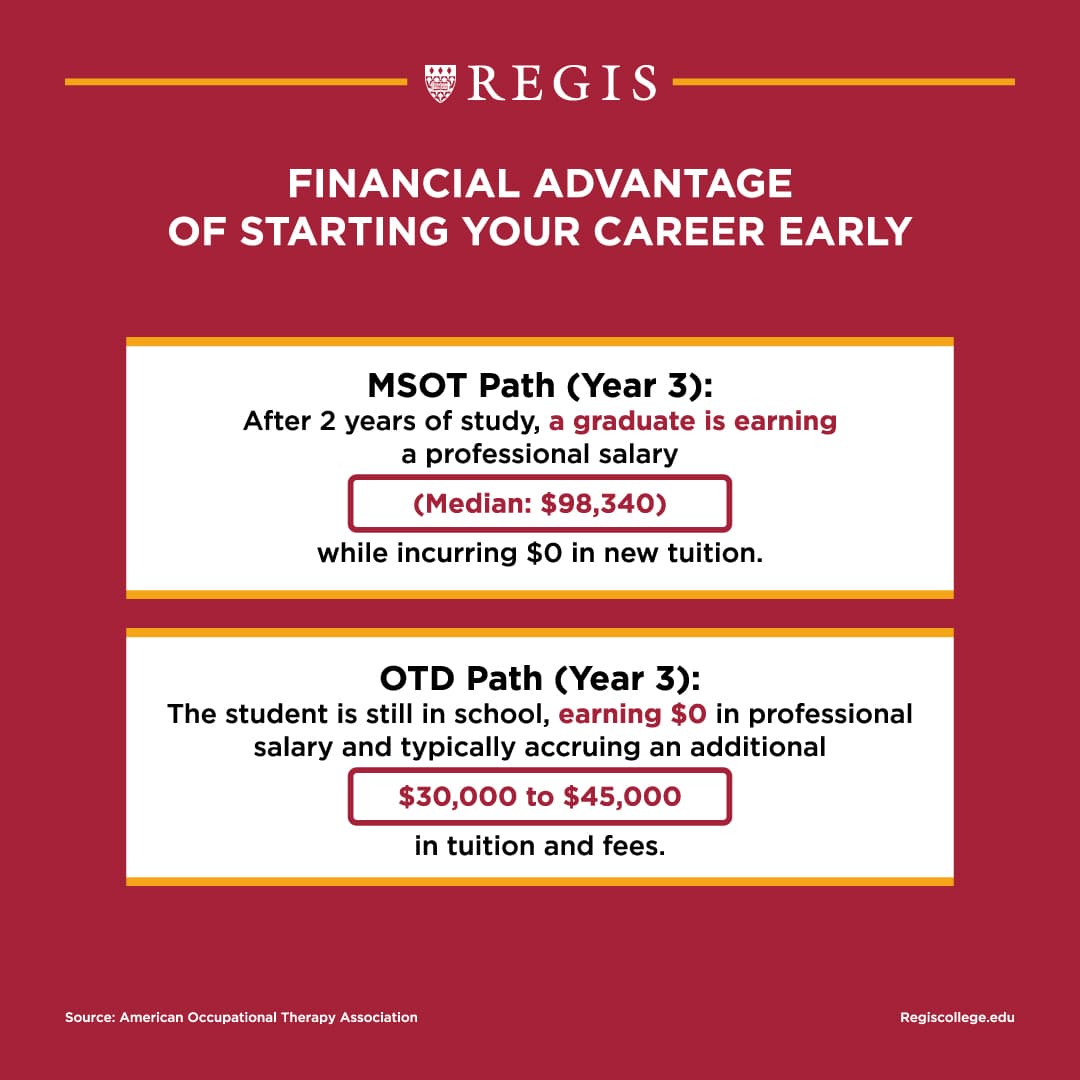
It may also be a better fit for students who are weighing cost and debt. The longer a program takes, the more students must factor in tuition, fees, living expenses, transportation, and time away from full-time work.
An MSOT can also leave room for future specialization. AOTA notes that all OT programs prepare students as generalists, and that specialization is typically something practitioners pursue after graduation and certification.
An MSOT may be especially appropriate if you:
- Want to become a practicing occupational therapist
- Prefer a shorter, clinically focused graduate pathway
- Are concerned about the cost of graduate education
- Want to enter the workforce as efficiently as possible
- Plan to pursue specialty certifications later
- Want to keep the option open to complete a post-professional doctorate in the future
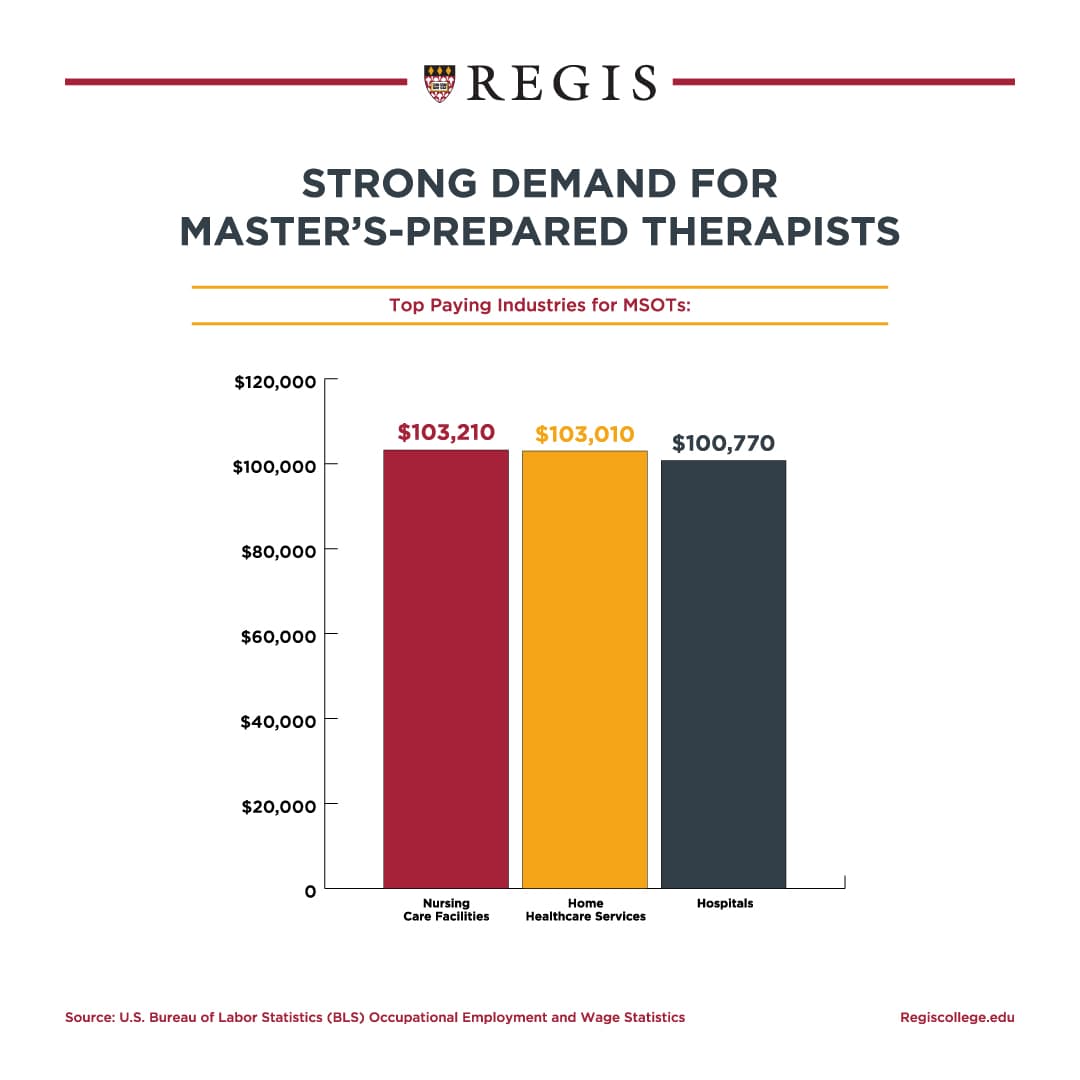
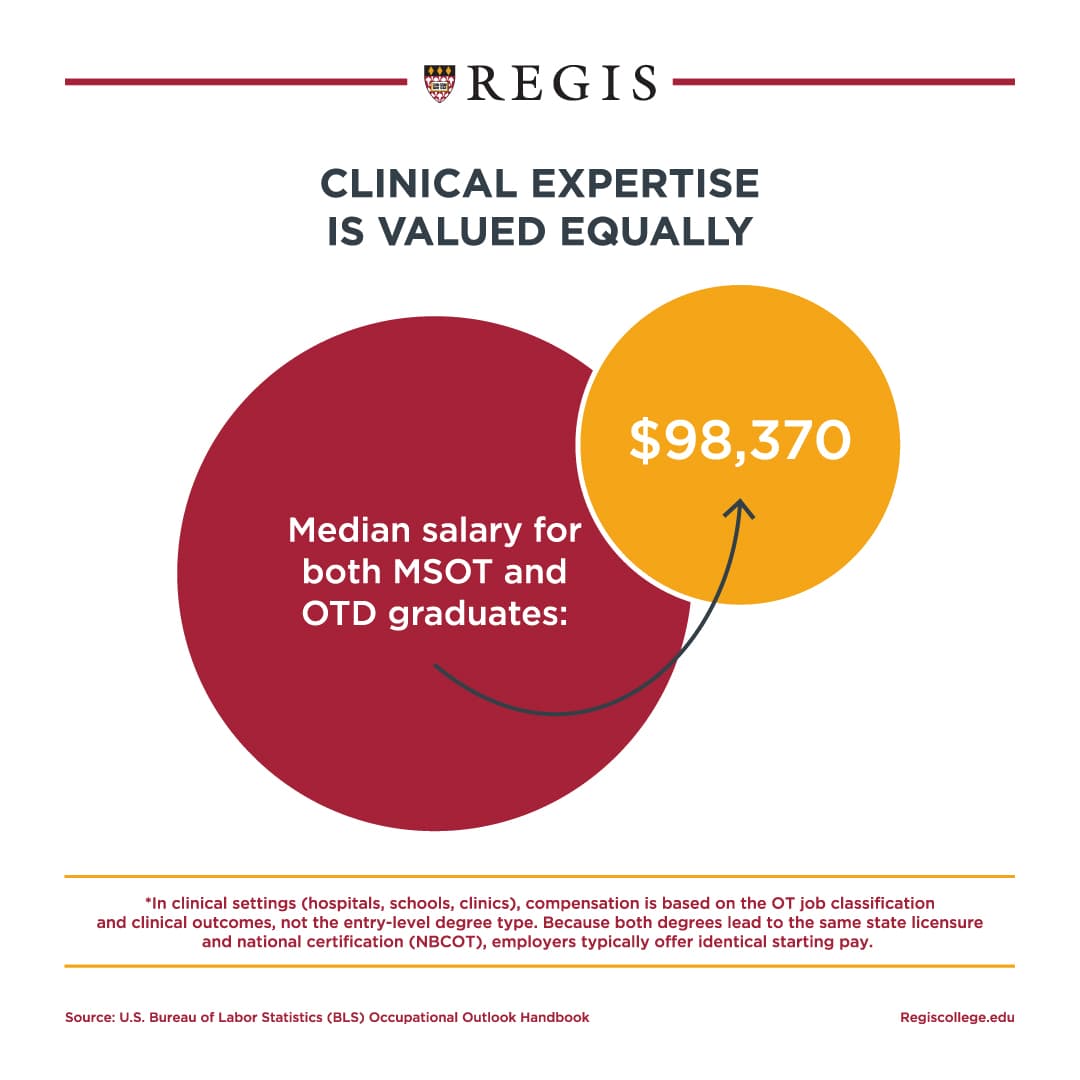
A master’s also allows graduates to quickly enter a field that continues to grow and offer strong earning potential for practitioners. The U.S. Bureau of Labor Statistics lists a master’s degree as the typical entry-level education for occupational therapists, with the median annual wage for occupational therapists being $98,340 in May 2024, and employment projected to grow 14 percent from 2024 to 2034.
But pay can vary by region, setting, experience, specialization, and demand. A new OT’s degree may matter less than their clinical readiness, communication skills, adaptability, and ability to serve clients effectively.
When an OTD May Be the Better Fit
An OTD may be the better choice if you want doctoral-level preparation from the beginning of your OT career, especially if you are interested in roles beyond direct clinical practice.
That may include students who are drawn to non-clinical roles and are considering whether they:
- Want doctoral-level preparation before entering the field
- Are interested in teaching, research, leadership, or policy
- Want to complete a doctoral capstone project
- Are drawn to program development or administration
- Are comfortable with a longer and potentially more expensive graduate pathway
- Know that the additional doctoral experience supports your long-term goals
The doctoral capstone gives OTD students the opportunity to develop deeper expertise in a focused area of interest after completing coursework and Level II fieldwork.
How Fieldwork Factors Into Both Degree Paths
Both MSOT and OTD students complete fieldwork, which is where classroom learning becomes supervised professional practice.
According to AOTA’s fieldwork FAQ, Level I fieldwork introduces students to practice and helps them apply knowledge to client needs, while Level II fieldwork requires at least 24 weeks of full-time experience, or the part-time equivalent, for occupational therapy students.
During fieldwork, students learn how to:
- Evaluate clients
- Develop treatment plans
- Document progress
- Communicate with families and other providers
- Adapt interventions based on a person’s goals and environment
- Respond to clients’ changing needs in real time
In the Regis MS in Occupational Therapy program, strong emphasis is placed on such experiential preparation. Regis offers fieldwork opportunities in hospitals, school systems, outpatient practices, community-based mental health, adapted sports, and other settings. The program also highlights that 100 percent of fieldwork experiences take place in clinical settings.
Patnaude says that early exposure to real people is one of the strengths of Regis’ approach.
“It’s really important to get out there with real people,” she says. “It’s a lot different to have a faculty member or a simulated patient pretend that they’re a patient with cancer and actually work with a patient who has cancer, or a patient who has an intellectual disability, or a patient who has a brain injury.”
For students comparing graduate programs, it's important to remember that, while degree title matters, so does the way a program helps students become confident, capable clinicians.
How Regis College’s MSOT Prepares Future Clinicians
Regis’ MSOT program is designed for students who want a clinically focused graduate experience in a small, close-knit environment near Boston.
“I think we have a very clinically based program,” says Patnaude. “It’s quick. You get out in two years. I feel like we have kind of a small-town feel, but we’re so close to Boston that you have access to excellent clinical placements.”
That combination is central to the Regis experience:
- A smaller cohort
- Personalized faculty attention
- Access to a major healthcare and education market
Regis is located close to Boston-area hospitals, school systems, outpatient practices, and community settings, giving MSOT students exposure to a wide range of professional environments.
The faculty model is also part of the program’s clinical focus. Regis notes that its OT faculty are active practitioners who bring current, real-world experience into the classroom. Patnaude says this helps students connect theory to actual practice.
“We can apply the information that we’re teaching them to real life,” she says. “I’m talking in real time versus, yes, there’s a lot of theory.”
The curriculum is structured to help students move quickly into applied learning. Regis requires prerequisite coursework such as:
- Anatomy
- Kinesiology
- Neuroscience
This allows graduate coursework to focus more directly on clinical application. Students then build skills through practice-oriented courses, labs, service learning, Level I fieldwork, and Level II fieldwork.
How to Decide Which OT Degree Path Is Right for You
Choosing between an MSOT and an OTD starts with being honest about your goals. These questions can help you evaluate which path better fits your career plans.
1. Do you primarily want to become a practicing clinician?
If your main goal is to work directly with clients, an MSOT may give you the preparation you need without adding doctoral-level requirements that may not be necessary for your immediate plans.
Both master’s and doctoral programs can prepare practitioners, so students focused on clinical practice should look closely at fieldwork quality, faculty experience, lab learning, and certification preparation.
2. Are you interested in academia, research, leadership, policy, or program development?
If you already know you want to teach, lead programs, conduct research, influence policy, or develop new models of care, an OTD may align more closely with those goals.
The doctoral curriculum and capstone are designed to support deeper work in areas beyond general entry-level preparation. Students who are not drawn to those areas may find that a clinically focused master’s program is a better match.
3. How important are time and cost?
Students who want to enter the workforce sooner or manage graduate debt may prefer a shorter master’s pathway, especially if their primary goal is licensure and clinical practice.
4. Do you want to specialize now, or after you begin practicing?
OT programs prepare students as generalists. If you are still exploring areas such as pediatrics, hand therapy, mental health, older-adult care, schools, or acute care, an MSOT can help you build broad clinical preparation before choosing a specialty. If you already have a focused doctoral-level interest and want to build a capstone around it, an OTD may be worth considering.
5. What kind of learning environment will help you succeed?
Program fit can shape your confidence, support system, and readiness for fieldwork. Some students thrive in large research-oriented institutions. Others prefer smaller cohorts, closer faculty relationships, and a strong clinical emphasis.
Regis’ small, clinically focused MSOT may appeal to students who want personalized attention and access to Boston-area clinical opportunities.
Which Path is Best for You?
Choosing between an MSOT and an OTD is not about choosing the “better” degree. It’s about choosing the degree that fits your goals.
If you want to become a practicing occupational therapist, an accredited MSOT program can provide the education, fieldwork, and preparation needed to pursue certification and licensure. If you want doctoral-level preparation tied to leadership, research, academia, advocacy, policy, administration, or advanced project work, an OTD may be a strong fit.
For students who want a clinically focused, efficient path into occupational therapy, Regis College’s Master of Science in Occupational Therapy offers a close-knit graduate experience, active-practitioner faculty, hands-on learning, and access to diverse fieldwork opportunities near Boston.
If your goal is to become a practicing occupational therapist through a clinically focused, fieldwork-rich master’s program, we invite you to explore everything that the Regis College Master of Science in Occupational Therapy program has to offer.
Ready to take the next step towards your career as an OT?




Published Date