
Most who enter the field of occupational therapy (OT) do so under the belief that meaningful activity can transform lives. But entry into that profession is specific—to become a licensed occupational therapist, you must complete an accredited master’s program, pass the NBCOT exam, and meet state licensure requirements.
So those considering OT as a career must ask a basic question: What will this degree actually cost, and how do people afford it?
Here, we’ll break down the cost of the Master of Science in Occupational Therapy (MSOT) at Regis College and walk through the financial aid options, scholarships, and practical strategies students commonly use to make this rigorous, career-building degree more affordable and financially manageable. We’ll also look at the long-term return on investment (ROI) that helps many students feel confident in moving forward.
Key Takeaways
- The Regis MSOT program requires 74 total credits (56 billed credits), with an estimated tuition of $95,200 for the 2025–2026 academic year, plus fees, insurance (if not waived), and living expenses.
- Students typically fund the degree using a mix of federal financial aid, payment plans, external OT scholarships, and employer tuition assistance, making the MSOT a manageable investment with proper planning.
- Regis offers an interest-free monthly payment plan and participates in the Strategic Partnership Program, which provides eligible employees of partner organizations a 10–25% tuition discount that can significantly reduce cost.
- The program delivers strong value through hands-on lab work, Level I and Level II fieldwork rotations, small class sizes, and faculty who are actively practicing occupational therapists.
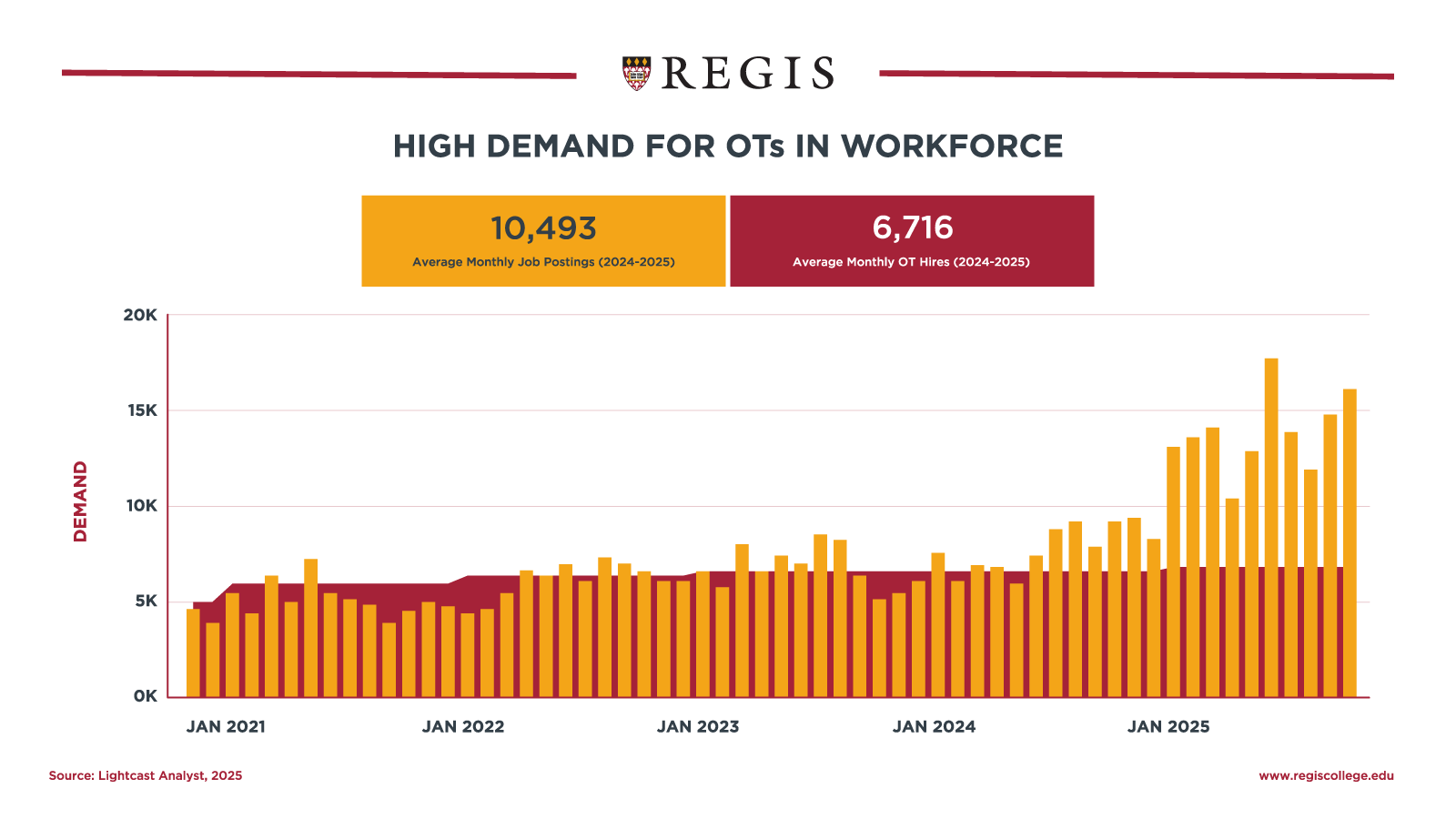
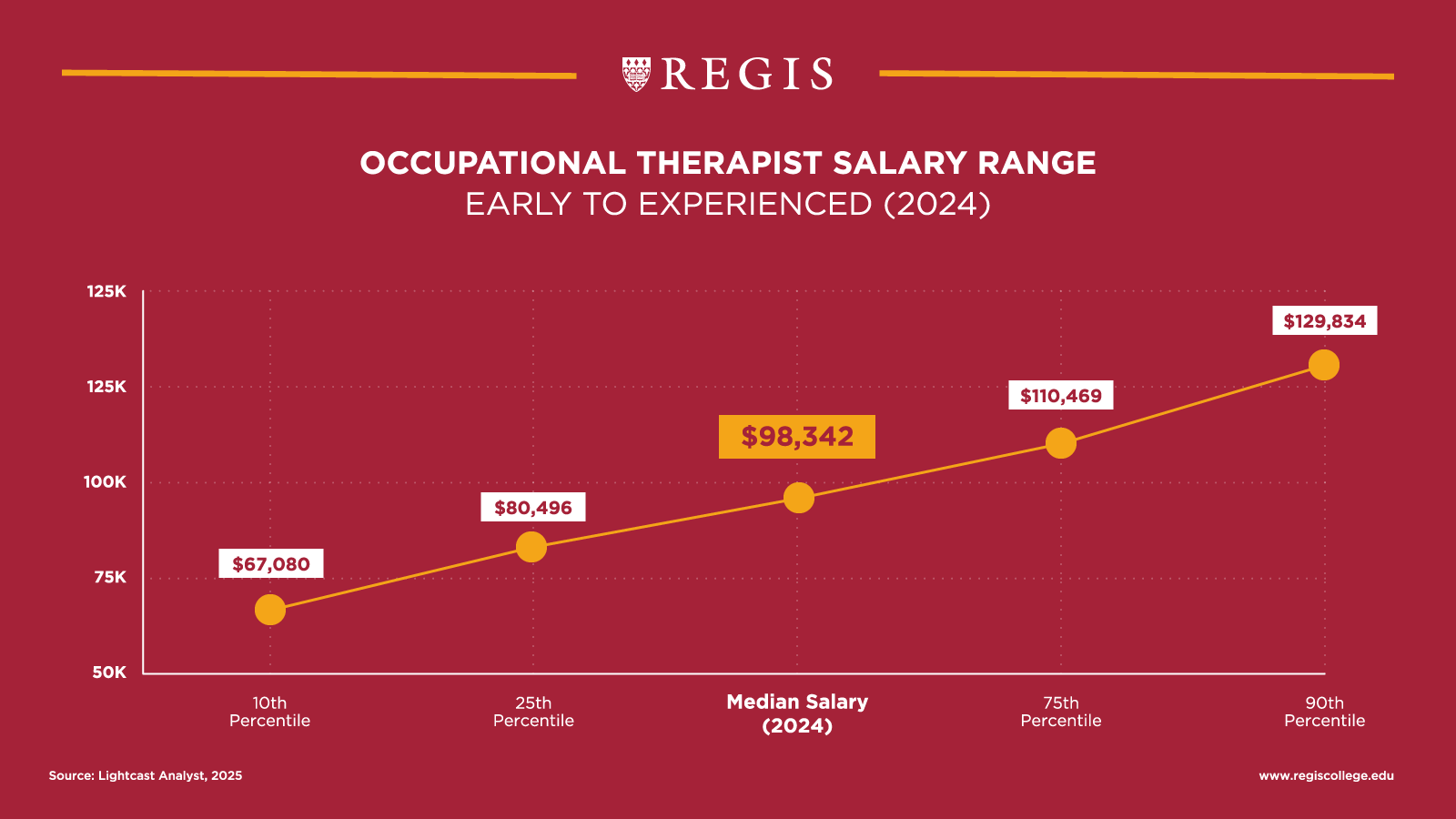
- Occupational therapists enjoy excellent job prospects, with median pay near $98,000 per year nationally and strong demand across hospitals, schools, outpatient clinics, home health, and community-based settings.
How Much Does Regis’ MSOT Program Cost?
Understanding the full MSOT program cost is one of the most important steps in planning for graduate school. Regis College provides clear, transparent tuition details for the academic year so students know what to expect:
- Total credits required for graduation: 74
- Billed credits: 56
- Cost per billed credit: $1,700
- Estimated total tuition: $95,200
It’s important to note that Regis differentiates between total program credits and billed credits. While students complete 74 credits of academic and fieldwork coursework, only 56 are billed at the graduate tuition rate. Fieldwork credits are not billed at the full graduate tuition rate.
Tuition costs are subject to annual updates.
Additional Estimated Fees
Students should also plan for typical graduate fees and expenses, which may include:
- Technology fee
- Graduation fee
- Health insurance (required unless waived)
- Lab materials and textbooks
- Fieldwork-related transportation
- Personal living expenses (housing, food, transportation)
Program Pace and Structure: Why It Matters for Cost Planning
Regis offers fall start and spring start pathways, and while tuition is the same, time-to-completion influences work schedules and cost-of-living planning.
Dr. Michael Roberts, associate professor, notes that the MSOT program is intentionally immersive: “You can expect to be very busy. Time management, empathy, emotional intelligence, and collaboration are essential skills. Students need to work together constantly—labs, group activities, exams, clinical reasoning—all while balancing fieldwork and academic expectations.”
Wondering If Occupational Therapy Is Right For You?
Download our free guide to gain insights about the career!

Ways Students Pay for an MSOT Degree
Paying for graduate school usually involves combining several types of financial support. Many MSOT students at Regis will use a mix of federal financial aid, scholarships, employer assistance, and payment plans, just like other OT students nationally.
Federal Financial Aid (FAFSA Required)
The first step for most graduate students is filing the Free Application for Federal Student Aid (FAFSA).
Eligible students may access:
- Direct Unsubsidized Loans: Up to $20,500 annually for graduate students.
- Graduate PLUS Loans: Covers the remaining cost of attendance after other aid.
- Federal Work-Study: Available to some students depending on need and position availability.
Filing early ensures access to all available federal funding.
Scholarships and Grants for OT Students
Scholarships can significantly reduce the net cost of graduate school.
Regis Strategic Partnership Tuition Discount
For students who work in healthcare, education, human services, or community-based organizations, the Regis Strategic Partnership Program can be a valuable way to reduce tuition. Through this program, employees of participating partner organizations are eligible for a tuition discount (typically ranging from 10–25%) on select Regis graduate programs, including the MSOT.
This benefit is especially helpful for students who are already working in roles connected to rehabilitation, health services, or school-based support—many of whom come to OT as career changers or seasoned paraprofessionals.
External Scholarships for OT Students
Students often apply for:
- AOTA / AOTF Scholarships
- AMBUCS Scholarships for Therapists
- State OT Association Scholarships (e.g., MAOT)
- Community foundation or healthcare-focused awards
Amounts range widely, but many awards run $500–$5,000 and can be combined.
Students may also be eligible for the MetroWest Health Foundation Scholarship—up to $4,000 for students from one of the 25 towns in Boston's MetroWest enrolled in nursing, medical, or clinical programs.
Payment Plans (Interest-Free Monthly Options)
Regis partners with Nelnet/MyCollegePaymentPlan to offer monthly, interest-free payment plans. This helps students:
- Reduce reliance on private loans
- Spread costs evenly across the semester
- Align tuition payments with work schedules
Employer Tuition Reimbursement or Education Assistance
Students who have worked in healthcare, education, or rehabilitation roles may have access to employer-sponsored tuition assistance. Many organizations—hospitals, school districts, home-health agencies—provide:
- Annual tuition support (up to $5,250)
- Professional development funds
- Career advancement benefits
Students should check with their HR departments early in the application process to confirm eligibility and annual limits.
Federal Loan Forgiveness Programs
Because many occupational therapists work in nonprofit or public settings, graduates may qualify for:
- Public Service Loan Forgiveness (PSLF): Applies to remaining Direct Loan balances after 120 qualifying payments while working for a nonprofit, school district, or government agency.
- Teacher Loan Forgiveness: Available to OTs working in certain education-based roles.
These programs can greatly reduce long-term loan burden.
Why the Regis MSOT Is a Smart Educational Investment
Beyond cost, students want to understand what their investment delivers. Several aspects of the Regis MSOT program directly support professional readiness and career success.
Hands-On Lab Learning in Nearly Half the Courses
Roberts notes that many courses incorporate labs—splinting, transfers, assistive technology, group dynamics, mental health practice, and others.
“If you like learning by doing, this is the program for you,” he says. “We have multiple fieldwork experiences and seven or eight lab-based courses where you're building real skills.”
Faculty Who Are Actively Practicing OTs
Students learn from faculty who continue to work in the field:
- Pediatrics
- Home care
- Hand therapy
- Mental health
- Adult and older-adult practice
Extensive, Diverse Fieldwork Opportunities
Regis integrates:
- Four Level I experiences
- Full-time Level II rotations (12 weeks total)
Fieldwork settings often include:
- Hospitals
- School systems
- Skilled nursing facilities
- Outpatient clinics
- Mental health settings
- Nontraditional sites (e.g., adapted sports, community-based practice)
Small Class Sizes for Personalized Support
Regis’ tight-knit cohort structure allows faculty to deeply understand each student’s strengths and clinical interests—strengthening support during:
- Fieldwork matching
- Professional development
- NBCOT exam preparation
Is an MSOT Worth It? Understanding the ROI
According to the U.S. Bureau of Labor Statistics: Occupational Therapists:
- Median annual salary (2024): $98,340
- Projected job growth (2024–2034): 14% (much faster than average)
- Job openings: Approximately 13,000 per year
- Top employers: Hospitals, schools, outpatient clinics, skilled nursing, home health
Roberts notes that recent Regis MSOT graduates make between $68,000 and $80,000 a year after leaving the program.
Why demand continues to rise
Occupational therapy promises to provide stable career opportunities into the foreseeable future for a variety of reasons, including:
- Growing older-adult population
- Increased focus on functional independence
- Expanded roles in mental health and community programs
- Need for pediatric OT in early-intervention and school-based settings
- Emerging areas: pelvic floor OT, long COVID rehabilitation, telehealth, assistive tech integration
For many students, these factors make repayment manageable and long-term job security strong.
Strategies to Make Your MSOT More Affordable
Practical habits can make graduate school more financially manageable. They might include:
1. Request Fieldwork Placements Near Home
Regis often places students close to where they live, reducing commute time and transportation costs.
2. Plan Work Hours Around Academic Load
Consider how you plan to manage work with your academic requirements, especially when entering into Level II fieldwork.
3. Use Monthly Payment Plans
Interest-free plans through Nelnet/MyCollegePaymentPlan can help spread tuition payments evenly across the semester.
4. Combine Multiple Funding Sources
Most students layer:
- Federal Direct + Grad PLUS loans
- Scholarships
- Employer assistance
- Payment plan
- Savings or part-time income
This reduces reliance on any one funding source.
5. Build a Detailed Cost-of-Living Budget
Include:
- Housing
- Food
- Transportation
- Insurance
- Fieldwork travel
- Books and materials
Budgeting ahead helps ensure financial readiness throughout the program.
Is the MSOT at Regis the Right Investment for You?
Earning a Master of Science in Occupational Therapy is a significant investment—but for students drawn to helping others regain independence and adapt to life’s challenges, it’s an investment with lasting impact.
Regis College’s MSOT program is designed to make that investment count: with immersive labs, practicing faculty, diverse fieldwork opportunities, small class sizes, and strong preparation for licensure and employment, the program equips graduates to enter the profession with confidence.
If you’re ready to begin this next chapter in your professional career, reach out to our team today and learn more about Regis’ MSOT program and how it can fit into your schedule.




Published Date