
If you’re considering returning to school to pursue a master’s in speech-language pathology, you probably have a few big questions that need to be answered:
- How long will it take?
- When do clinicals actually start?
- Can I balance this with real life?
Regis College’s Master of Science in Speech-Language Pathology (MS SLP) offers a clear, efficient path that has been designed with commuter students and career changers in mind. The program blends focused coursework with early, real-world clinical placements so you graduate ready to step into your Clinical Fellowship (CF) and begin your career.
At a glance, Regis’ pathway from start to graduation, with one summer term in between, provides the structure and support that reflect the program’s mission to prepare clinicians to serve a diverse population across multiple settings and the entire lifespan.
We’ll look at how long it will take you to complete your degree at Regis, tips on how to fit everything into your personal and professional schedule, and advice as to how to pre-plan before enrolling, so as to ensure you’re ready for the time commitment.
Key Takeaways
- Regis’ SLP program timeline follows a clear 21-month arc—September start, one summer in the middle, and May graduation—so you’re on a predictable runway to your Clinical Fellowship.
- Off-campus clinicals typically begin in spring of year one at about three days per week, accelerating real-world experience without waiting for an on-campus clinic slot.
- The program’s flexible scheduling and placements near where you live make it easier to balance coursework, travel time, and personal commitments.
- A small, close-knit faculty emphasizes mentorship and consistency, which helps students build confidence and clinical independence faster.
- By graduation, students are positioned to meet ASHA’s hour requirements and pass the Praxis, enabling a smooth transition into CF roles across schools, private practices, and healthcare settings.
How Long Does It Take? A Semester-by-Semester Timeline
Choosing a graduate SLP program comes down to timing, structure, and fit. Here’s how the Regis MS in SLP typically unfolds from your first semester through graduation.
Fall One (Year One): Foundations and Clinical Readiness
Your first term focuses on core knowledge—Speech-Language Pathology in Schools; Evaluation and Clinical Writing; Child Language Disorders; Autism Spectrum Disorder and Related Disability; Internship. Expect applied assignments (e.g., goal writing, SOAP notes, case analysis) to build a clinical lens for the semester ahead.
The outcome is that you are academically and professionally prepared to enter your first off-campus placement next term.
Spring One (Year One): First Off-Campus Clinical Placement (Typically Three Days/Week)
Clinicals typically begin in your second semester. You’ll split time between advanced coursework and an off-campus externship in settings such as schools, private practices, hospitals, or rehab/Skilled Nursing Facility (SNF) sites—generally three days per week. The off-campus model prioritizes authentic caseloads and continuous client contact, helping you develop documentation, collaboration, and time-management skills that transfer directly to the workplace.
Summer (Between Years One and Two): Momentum and Hours
You’ll keep building knowledge and clinical hours over the summer with a schedule that’s designed with flexibility in mind. This continuity helps you retain skills and accelerate progress toward the clinical hour benchmarks required for certification.
Fall Two (Year Two): Second Placement and Advanced Responsibilities
With a semester of clinical experience behind you, you’ll take on more complex cases and greater independence—expanding assessment/treatment planning, strengthening interprofessional collaboration, and, if you choose, deepening interest areas such as AAC (augmentative and alternative communication) through targeted coursework and cases.
Spring Two (Year Two): Final Placement and Transition to CF
Your final term consolidates clinical independence and prepares you for the Praxis® exam while you complete remaining hours and finalize your Clinical Fellowship (CF) plans. By graduation, students typically meet or exceed ASHA clinical practicum requirements (minimum 400 hours, including 25 observation and 375 direct), positioning you to move quickly into CF roles.
According to Allan Smith, PhD, CCC-SLP, Program Director for the MS in Speech-Language Pathology at Regis College, “...When someone says it’s a two-year program, I’m quick to point out that it’s one summer and you start in September, graduate in May.”
What to Expect: Coursework, Clinicals, and Scheduling
Geography helps to shape the program’s design, as Smith describes: “They [students] tend to be from Eastern Massachusetts. They’re commuters… We make the schedule so it makes sense for commuters.”
Early terms emphasize intensive academic preparation. As clinicals start in Spring One, schedules shift to accommodate three days per week in placement along with courses.
Without an on-campus clinic, students spend more time with actual caseloads and less time waiting between half-hour sessions. The result: denser, higher-value client contact and a smoother transition to CF roles.
Smith contrasts Regis’ small, collaborative faculty with “weed-out” environments at some large programs, concluding, “It sounds corny but [the cohorts are] more like a family.” That cohesion matters when you’re juggling classes, clients, and life, and it often translates into faster problem-solving and consistent guidance.
Clinical Placements: Meeting ASHA Standards in Real-World Settings
To become certified (CCC-SLP), ASHA requires a minimum of 400 supervised clinical hours, including at least 25 hours of guided observation and at least 375 hours of direct client/patient contact.
Regis’ off-campus placement model is built to help you reach and surpass those thresholds while developing authentic, employer-ready skills:
- Start early: Placements typically begin in Spring One (your second term).
- Commitment you can plan for: Expect three days per week at your site during clinical semesters.
- Settings across the spectrum: Schools, private practices, hospitals, rehab/SNF sites—exposure that builds versatility for the job market.
- Placement geography that fits life: The program aims to place students near where they live, reflecting its commuter-friendly mission.
- Skill development employers notice: Beyond checkboxes and hour totals, Smith points to traits that matter at work: “I think it’s more important to be… good with people… understanding, patient… and you really need a very broad skill set.”
- Off-campus placements accelerate those interpersonal and adaptability muscles.
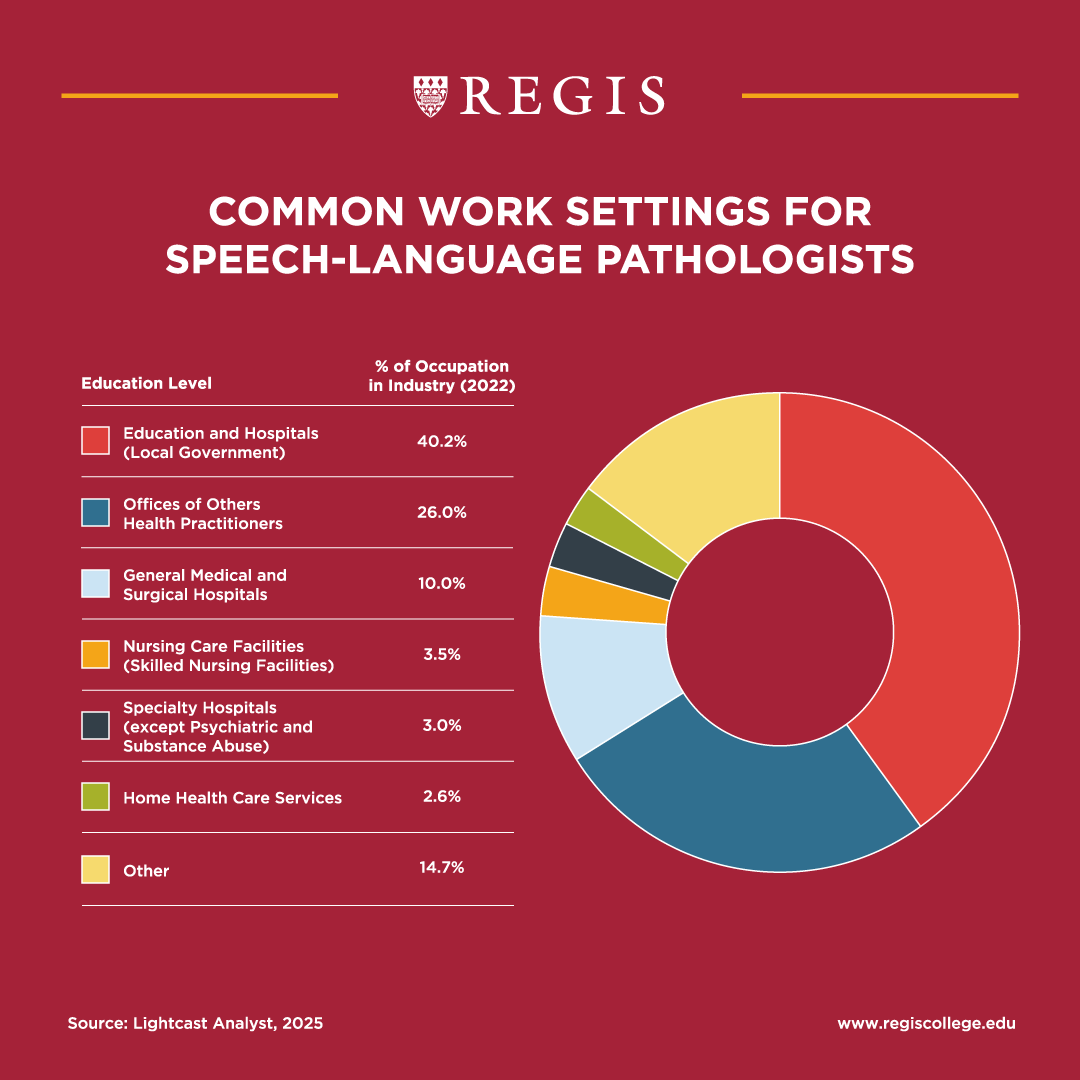
Where Regis Graduates of MS SLP Work
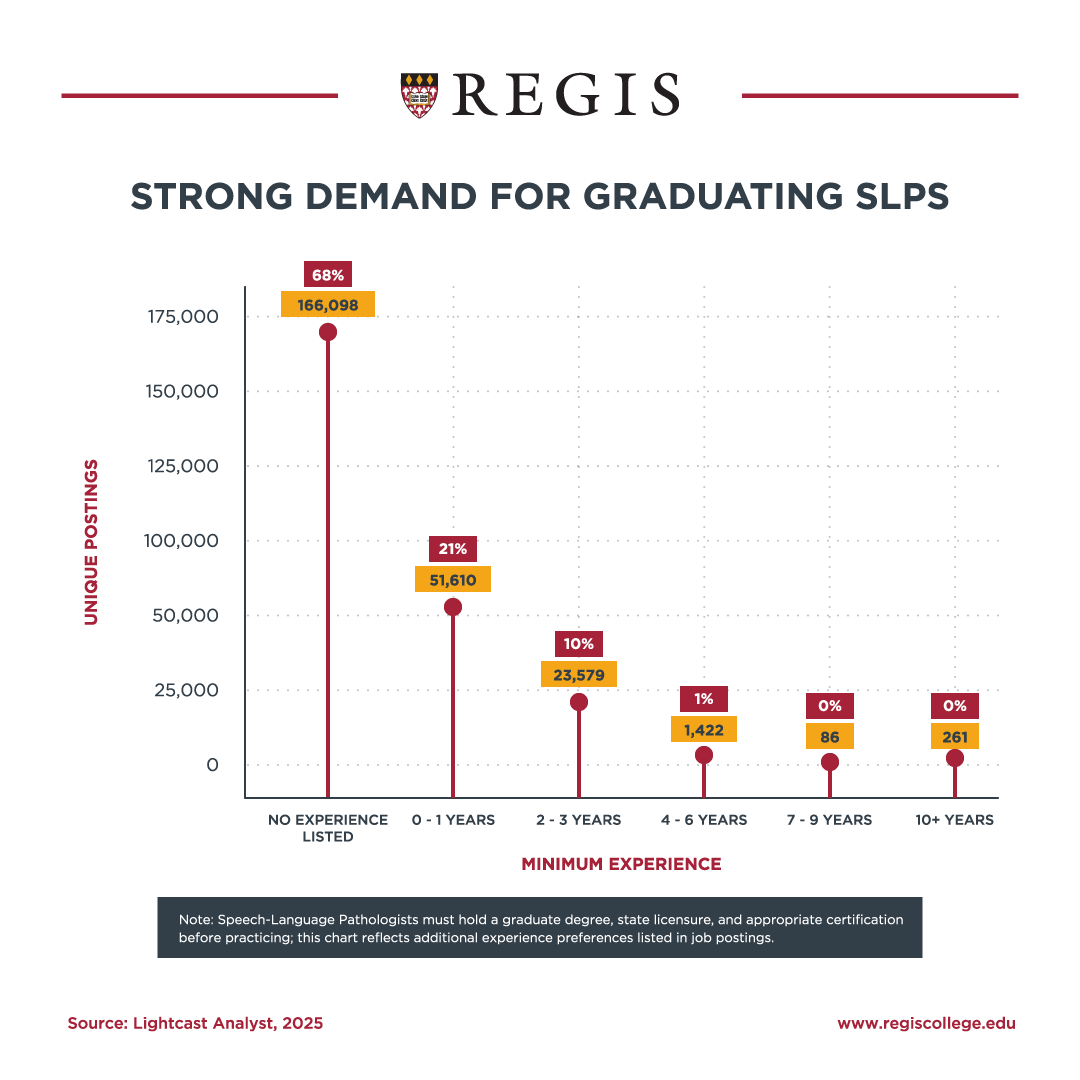
A condensed, predictable 21-month timeline gets you into the job market sooner—important in a high-demand field. Nationally, employment for SLPs is projected to grow 15% from 2024–2034, with a median wage of $95,410 (May 2024).
“For our students in particular we have 100% employment,” Smith reports. “Most of them go to schools or private practices. A few have gone to hospitals.”
The program’s breadth and the off-campus model help you graduate with credible experience across ages and settings, exactly what school districts, private practices, and medical providers look for in Clinical Fellows.
Who Thrives at Regis?
From curriculum choices to scheduling nuances, Regis is intentionally designed for a specific kind of graduate student:
- You value personal attention over prestige branding, fitting nicely with the program’s culture of collaboration and student-centeredness.
- You want momentum, not drift. A clear 21-month plan (with clinicals starting in Spring One) keeps you progressing toward CF without unnecessary delays.
- You want real-world client time. Off-campus placements maximize contact hours and mirror the documentation, collaboration, and time-management rhythms of actual practice.
Tips to Balance the Timeline
- Plan around the three-day clinical rhythm. Treat placement days like full-time professional days.
- Protect your mornings and afternoons to match site hours.
- Batch administrative tasks. Dedicate a consistent weekly window to documentation and Praxis prep; small, steady effort beats cramming.
- Leverage commuter-friendly scheduling. Regis purposefully arranges classes to avoid peak traffic where possible—use those margins for rest or quick study blocks.
- Stay close to your faculty. In a small program that’s “more like a family,” it’s easy to ask for help early and often.
Questions to Ask Yourself
1) Does a 21-month, September-to-May timeline match my life over the next two academic years?
Regis is intentionally concise—one summer in the middle and graduation the following May—so you move into CF sooner. If you’ll need pauses or a lighter load, explore the sequencing options on the curriculum and sequences page to see how part-time or alternative pacing could work for you.
2) Am I ready for off-campus clinicals to start in Spring of Year One—typically three days per week?
You’ll be in real community settings (schools, private practices, hospitals/SNF), which means authentic caseloads, documentation, and collaboration from early on. That can be a great accelerator, if you can reliably protect those three days. If not, think through commute time, employer flexibility (if you work), and family logistics now.
3) Do I prefer a smaller, close-knit faculty culture over a large program with many instructors?
Regis’ small team emphasizes mentorship, consistency, and commuter-friendly scheduling. If you thrive with frequent feedback and clear expectations, this can shorten the learning curve. If you want broad menus of subspecialty electives or large-campus clinic operations, weigh that against the benefits of consistent, relationship-based training.
4) Where do I want to build experience, and will placements near where I live help me get there?
The program aims to place students near their home base, which can support efforts to balance work and life commitments and help cement local networks for CF and first jobs. If you’re targeting a specific setting (e.g., schools, AAC-heavy caseloads, or medical rehab), ask how prior students have aligned placements with those goals.
5) Do I have a plan for ASHA requirements, Praxis®, and CF timing?
You’ll need at least 400 supervised hours to qualify for certification, then pass the Praxis and complete your Clinical Fellowship. Laying out when you’ll take Praxis (near graduation vs. early CF) keeps your timeline clean.
Fit Your SLP Education into Your Schedule
If you’re seeking a clear, efficient, and supportive route to becoming an SLP, Regis’s 21-month plan—with early off-campus clinicals and a commuter-sensitive cadence—offers a compelling path to your Clinical Fellowship.
The structure is built to help you meet ASHA’s requirements on time, cultivate the interpersonal and problem-solving skills employers prize, and enter a field with strong job growth and competitive pay.



Published Date