
If you’re drawn to helping others communicate and connect, chances are you’ve come across two standout professions: speech-language pathology and audiology.
Both careers play vital roles in improving lives, helping individuals speak, listen, and engage more fully with the world around them. Yet while these fields share some overlap, they differ significantly in focus, training, and day-to-day work. Understanding those differences can help you determine which aligns best with your professional goals as well as your personal strengths.
For many aspiring clinicians who want a hands-on, people-centered role that’s accessible with a master’s-level degree, speech-language pathology (SLP) may be the best fit. And if you’re seeking a supportive, commuter-friendly program that blends rigorous training with individualized faculty attention, Regis College’s Master of Science in Speech-Language Pathology (MS in SLP) provides a clear path forward.
Key Takeaways
- Speech-language pathologists (SLPs) help individuals overcome communication and swallowing challenges through hands-on therapy, while audiologists diagnose and treat hearing and balance disorders.
- Becoming an SLP typically requires a master’s degree and can be completed in about 21 months at Regis College, whereas audiologists need a Doctor of Audiology (AuD) that takes three to four years.
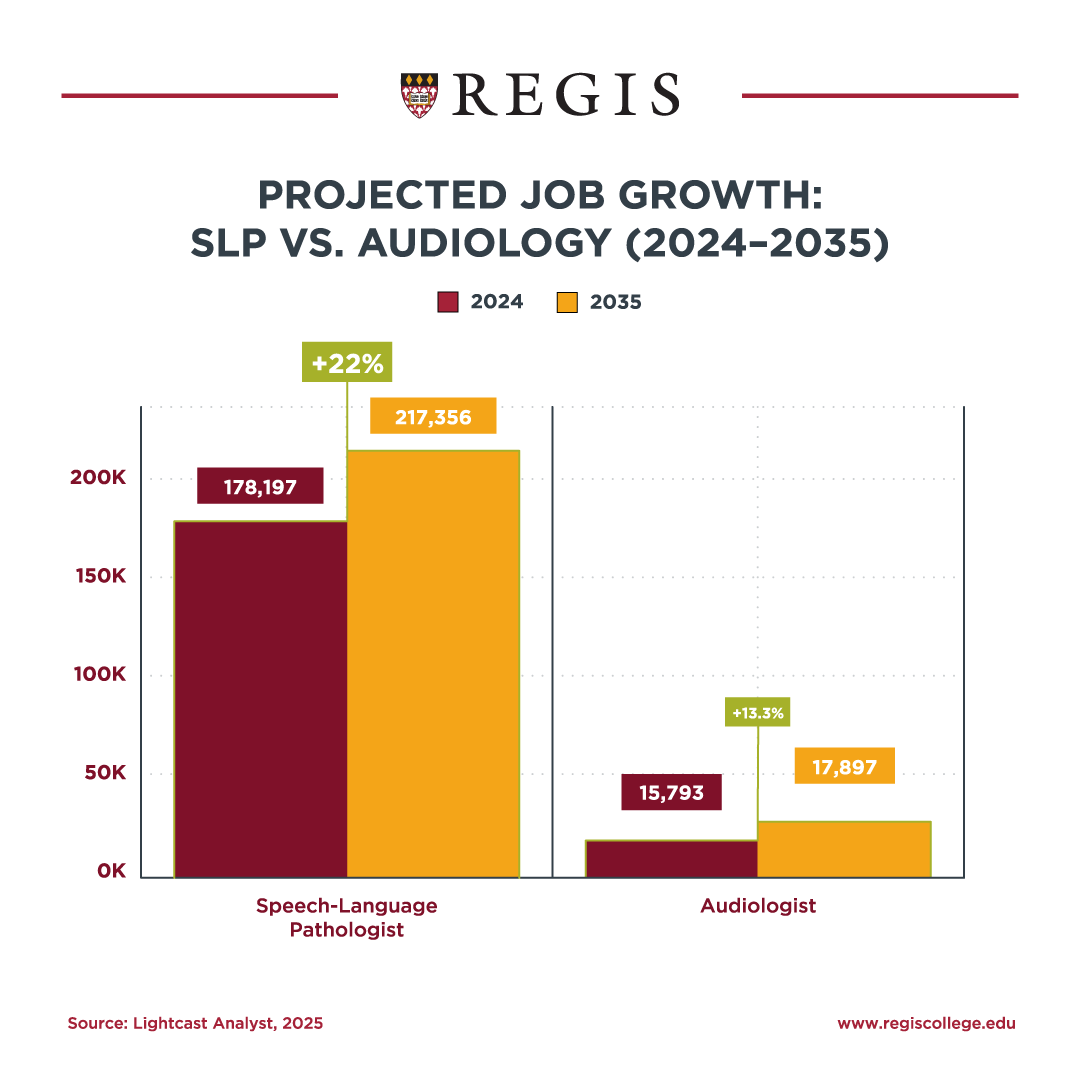
- SLPs enjoy stronger job growth and employment opportunities than audiologists and can work in schools, hospitals, and private practices.
- Regis College’s MS in Speech-Language Pathology program offers small class sizes, commuter-friendly scheduling, and 100% job placement, helping graduates enter the field confidently.
- Choosing between SLP and audiology depends on your interests — communication and therapy (SLP) versus technology and diagnostics (audiology).
SLP vs. Audiology: What’s the Difference?
Both speech-language pathologists (SLPs) and audiologists work to assess and treat communication challenges, but their focus areas differ:
Speech-language Pathology
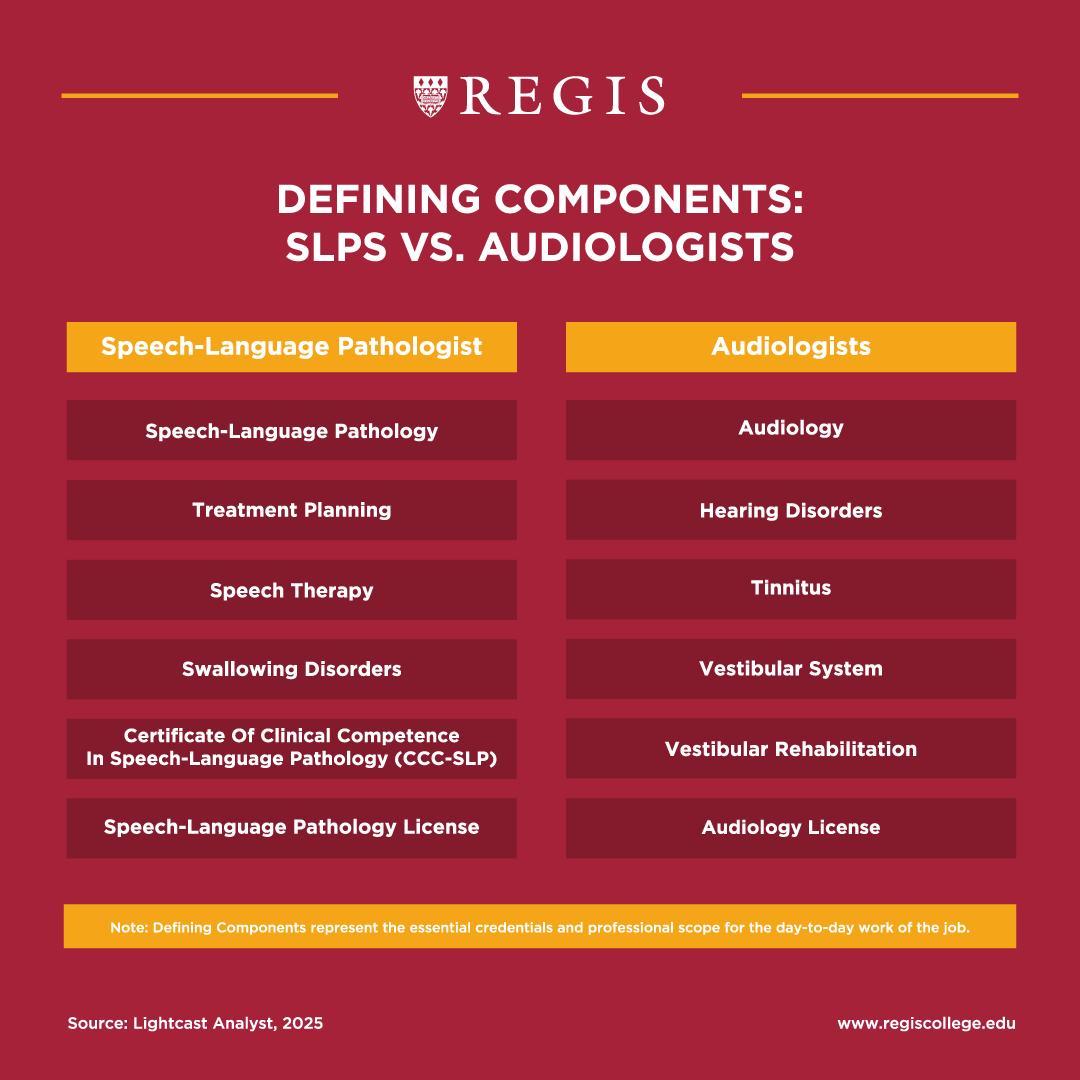
SLPs evaluate and treat disorders related to speech, language, voice, fluency, and swallowing. They help children with language delays, individuals recovering from strokes, and adults with conditions like stuttering, aphasia, or dementia. Their work often involves therapeutic interventions that build or restore communication skills over time.
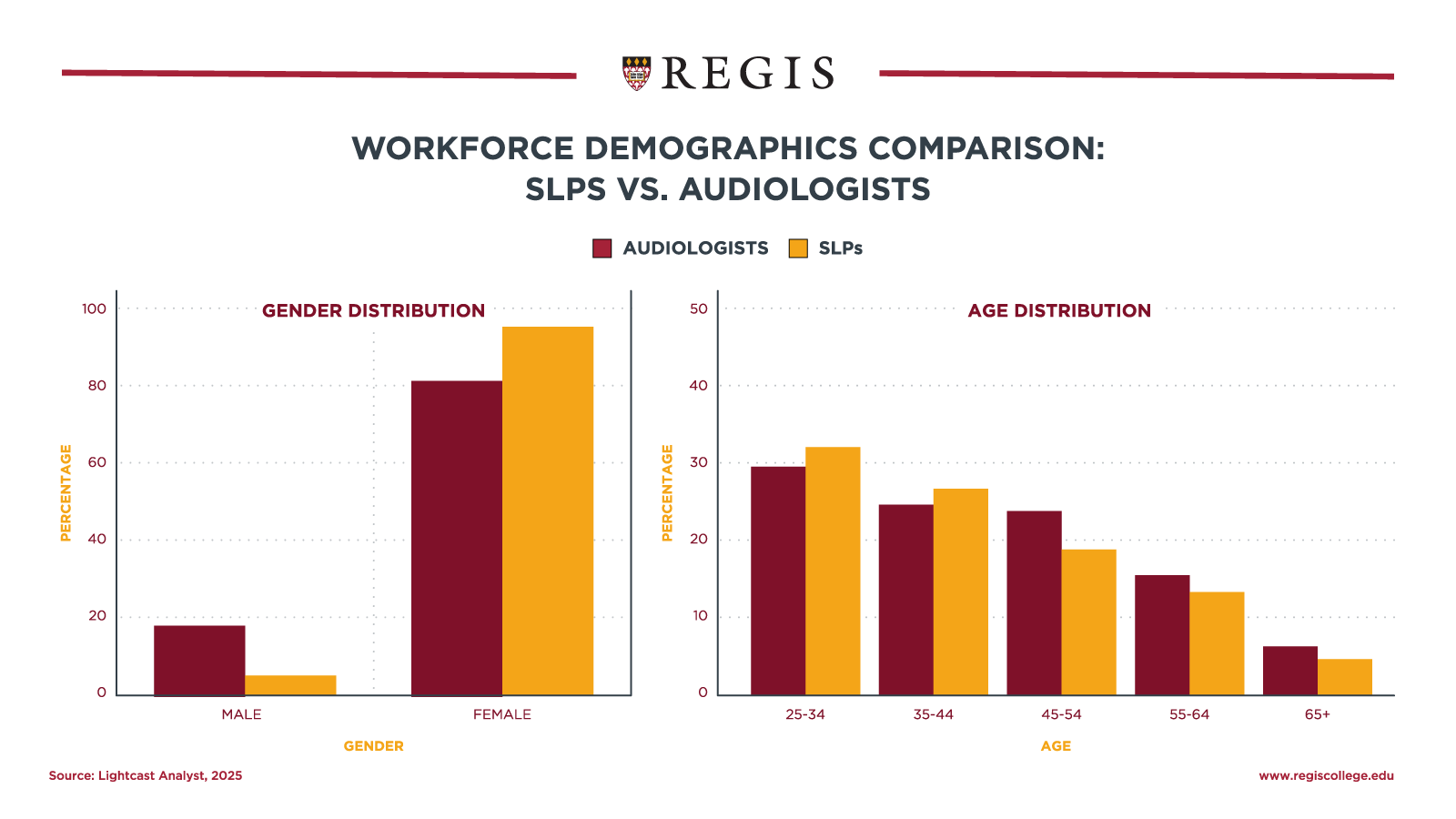
SLPs are employed in diverse settings including schools, hospitals, private practices, and nursing facilities, where they serve patients across the lifespan.
Audiology
Audiologists specialize in hearing and balance disorders. They conduct hearing tests, fit and program hearing aids or cochlear implants, and help patients manage tinnitus or vestibular problems. They typically work in clinics, physicians’ offices, and hospitals, and may travel between multiple sites.
To put the difference between SLPs and Audiologists in the simplest terms:
- SLPs help people express and understand language.
- Audiologists help people hear and process sound.
Both careers are crucial, but they appeal to different motivations. Regis MS in SLP Program Director Allan Smith, PhD, CCC-SLP, notes that speech-language pathology tends to attract people who are curious, compassionate, and eager to work closely with others across many stages of life—people who want to see a direct, human impact from their work every day.
Educational Path and Credentialing for SLPs and Audiologists
While both careers require graduate-level education and clinical training, their time commitments and credentials differ considerably.
Speech-Language Pathology: The Master’s Route
To become a licensed SLP, you’ll typically need:
- A Master of Science in Speech-Language Pathology from an accredited program
- Completion of 400 supervised clinical hours (including 25 hours of observation) as outlined by the American Speech-Language-Hearing Association (ASHA)
- Successful completion of the Praxis exam and a Clinical Fellowship (CF)—a mentored, post-graduate experience required for ASHA’s Certificate of Clinical Competence in Speech-Language Pathology (CCC-SLP).
At Regis College, students can complete their master’s degree in about 21 months. “When someone says it’s a two-year program, I’m quick to point out that it’s one summer—you start in September and graduate in May,” says Smith. Regis offers both full-time (21-month) and part-time (four-year) tracks, accommodating career changers and commuters alike. The 56-credit curriculum includes courses in:
- Child Language Disorders
- Motor Speech Disorders
- Aphasia
- Cognitive-Communication Disorders
- Augmentative and Alternative Communication (AAC)
- Counseling and Professional Issues
From the second semester onward, students begin off-campus clinical placements three days a week, gaining real-world experience in schools, hospitals, or private practices. Smith emphasizes that in-community clinicals provide students the opportunity to spend full, productive days at their sites and earn clinical hours more efficiently instead of waiting around between occasional clients.
Audiology: The Doctoral Path
In contrast, audiologists must earn a Doctor of Audiology (AuD), a clinical doctorate that typically takes three to four years to complete. Certification through ASHA’s Certificate of Clinical Competence in Audiology (CCC-A) or the American Board of Audiology also requires extensive practicum hours and a passing score on the national exam.
This longer educational timeline can be an important deciding factor. While both fields require strong academic commitment, the master’s-level entry point for SLPs makes it a more accessible and flexible path for many students.
Skills Needed for SLPs and Audiologists
Both careers demand scientific knowledge, empathy, and communication skills, but they differ in the type of problem-solving and interpersonal interaction required.
SLPs thrive when they’re:
- Patient, adaptable, and curious about human behavior
- Comfortable toggling between working with children, adults, and older adults
- Skilled at building trust and motivating clients through long-term therapy
- Interested in both science and the art of communication
Smith stresses that success in SLP has less to do with being perfectly organized and more to do with being understanding, patient, and genuinely good with people. He notes that clinicians need a broad skill set—able to talk with an older adult in a nursing home in one session, then engage a four-year-old in the next.
Audiologists are often detail-oriented and technologically inclined. They excel when they enjoy diagnostic testing, device calibration, and data analysis, alongside counseling patients on hearing-loss management.
Smith notes that while both fields serve people, their daily rhythms and culture differ: audiology tends to be more equipment- and data-driven, whereas speech-language pathology leans more toward communication, flexibility, and personal connection.
Career Outlook and Opportunities
Both speech-language pathologists and audiologists enjoy strong job security and above-average pay, but SLPs currently have the edge in job growth and opportunities.
Speech-Language Pathology
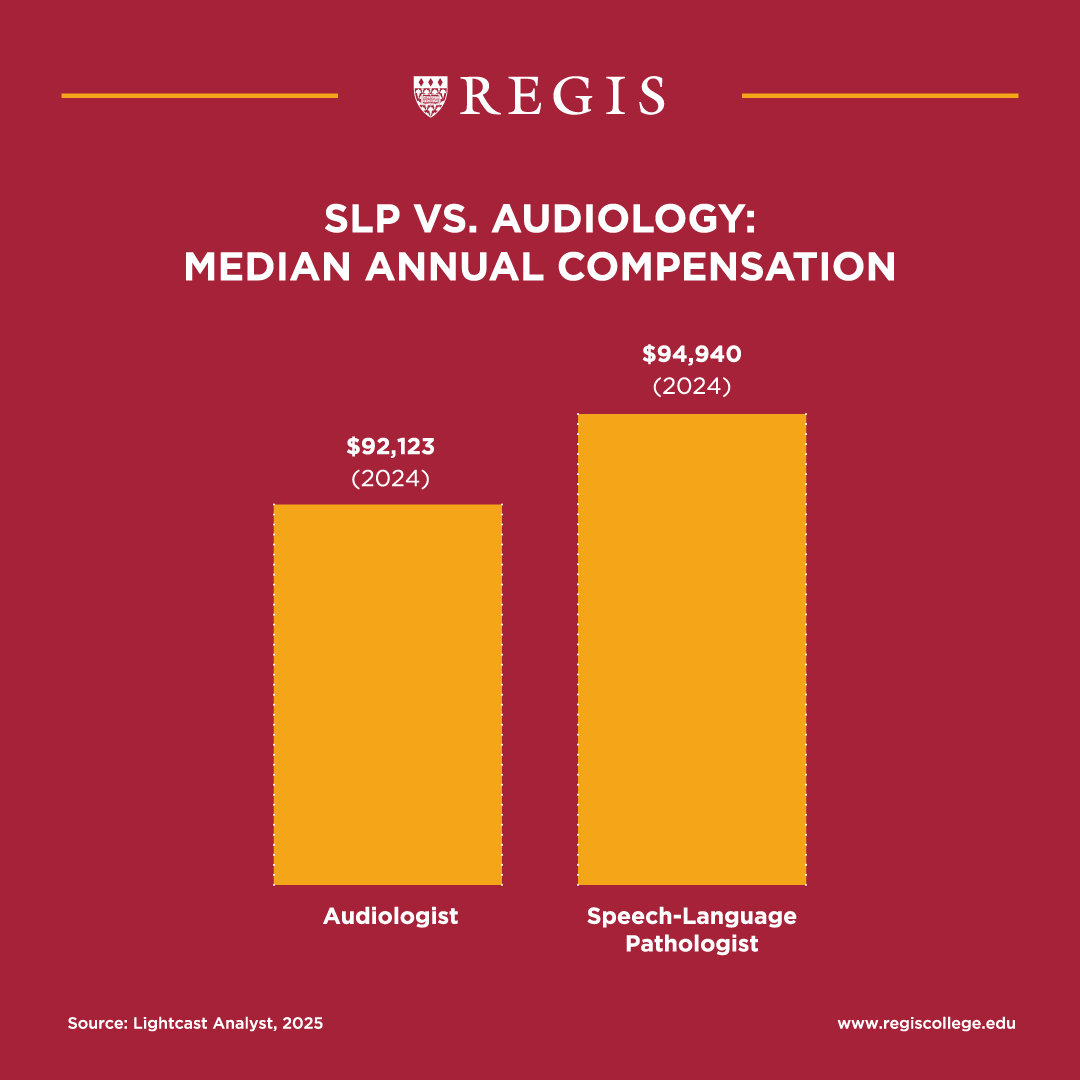
The median annual wage for SLPs was $95,410 in 2024, with employment projected to grow 15% from 2024 to 2034—much faster than average. Roughly 13,300 job openings are expected each year due to retirements and growing demand.
Key drivers include:
- An aging population facing speech, voice, and swallowing disorders
- Increased early identification of language and communication issues in children
- Expanded access to telepractice and rehabilitation services
Regis College reflects that strength in its own outcomes: 100% of graduates find employment within one year, with a 94% Praxis pass rate and 98% on-time completion rate over the past three years
Most Regis alumni enter school-based or pediatric private-practice settings, though some pursue hospital and rehabilitation roles. Smith notes that graduates aren’t just landing positions—they are stepping into careers where they’re ready to make a difference from day one, which is reflected in the program’s strong employment outcomes.
Audiology
The median annual wage for an audiologist was $92,120 in 2024 and a 9% job growth rate through 2034—also faster than average, but with a smaller number of openings (around 700 per year). While demand is stable, audiology is a smaller field overall, with far fewer audiologists than speech-language pathologists nationwide.
Many audiologists work in medical environments with specialized equipment, which can be ideal for those who enjoy a clinical-lab hybrid career.
Why Choose Regis for Your SLP Journey
For those leaning toward speech-language pathology, Regis College offers a program uniquely designed to support students from diverse academic and professional backgrounds.
A Student-Centered Approach
Regis’ MS in Speech-Language Pathology is accredited by the Council on Academic Accreditation (CAA) of the American Speech-Language-Hearing Association (ASHA), and stands out for its small, close-knit environment.
Smith explains that the faculty maintains a continuous, collaborative dialogue—by text, in the hallway, and on Zoom—to ensure the best outcomes for every student. Smith adds that this level of commitment creates a program that feels more like a family than a competitive, 'weed-out' culture.
Commuter-Friendly and Flexible
Many Regis students come from Eastern Massachusetts and commute to campus. The schedule is designed with that in mind—courses run in sequences that avoid heavy traffic times and align with part-time work or family responsibilities.
Hands-On, Real-World Learning
Regis’ off-campus clinical model ensures that every placement counts. Students begin external practicum early, typically in their second semester, and the program staff works to secure placements close to students’ homes.
This practical, community-based approach prepares graduates to transition seamlessly into full-time professional roles. Combined with Regis’ 100% employment rate, it demonstrates how effectively the program connects classroom theory with fieldwork.
Still Deciding? Ask Yourself These Questions
For those weighing whether speech-language pathology or audiology fits your goals, consider the following:
1. What kind of clients do I want to work with?
If you’re excited about helping children overcome speech or language delays, or supporting adults recovering from neurological events, SLP offers that interpersonal connection.
If you prefer diagnostic testing and the technical side of hearing and balance care, audiology may be a stronger match.
2. Am I more drawn to communication or technology?
SLPs focus on human interaction, language, and therapy. Audiologists specialize in equipment, testing, and hearing technology.
3. How much time and financial investment can I make?
The master’s-level SLP path (21 months at Regis) may appeal to those seeking a faster transition into clinical practice. The AuD route requires an additional year or two of study, and the higher tuition that comes with it.
4. Do I want variety in my day-to-day work?
SLPs often see patients across age groups and conditions, while audiologists typically work with a narrower patient demographic.
5. What motivates me most?
If you value personal connection, variety, and helping others communicate, SLP may be your calling. If you love precision, diagnostics, and technology, audiology could be the right fit.
Which Career Path Is Right for You?
Both speech-language pathology and audiology offer fulfilling, high-impact careers dedicated to improving quality of life. The difference lies in where your interests and talents intersect—whether that’s in human communication and therapy, or hearing science and diagnostics.
For many prospective students, the master’s pathway to speech-language pathology offers an ideal balance of academic rigor, career flexibility, and personal reward. At Regis College, that journey is supported by small class sizes, personalized faculty mentorship, and hands-on experience that prepares graduates for real-world success.
If you’re ready to take the next step, explore the MS in Speech-Language Pathology program at Regis College to see how you can turn your passion for communication into a meaningful career.
Published Date