
Career Impact, Speed to RN, and Outcomes
You’ve built a career, but whether it’s limited growth, unpredictable layoffs, or work that no longer feels meaningful, you might be wondering whether it’s time for a change. And with nursing projected to remain one of the most in-demand and secure professions for years to come, it’s no surprise that many mid-career professionals start asking the same question:
Would an Accelerated Bachelor of Science in Nursing (ABSN) be worth it?
For many career changers, the answer is yes. An ABSN offers a faster, more direct path into a stable, respected, and well-paying field, often in less than two years. But because these programs are rigorous and require a substantial commitment of time, energy, and tuition, prospective students want clarity: What do you really get for the investment? Will the outcomes justify the commitment? How quickly can you become an RN?
That’s why well-respected ABSN programs—such as the 16-month campus-based Accelerated BSN track at Regis College—provide career changers pathways into nursing, matched to different needs while offering the same strong preparation for RN licensure.
Key Takeaways
- An ABSN can be a strong investment for career changers, offering faster entry into a stable, high-demand, and well-compensated nursing profession.
- Career outcomes for ABSN graduates are consistently strong, with national RN salaries, job mobility, and specialization opportunities driving long-term ROI.
- Program quality varies and directly impacts outcomes, with clinical preparation, faculty expertise, and licensure success rates serving as critical factors when choosing a program.
- Regis College’s ABSN programs stand out for strong NCLEX pass rates, a flexible 16-Month pathway, and deep clinical partnerships in the greater Boston area.
What Is an ABSN, and Why Do Career Changers Choose It?
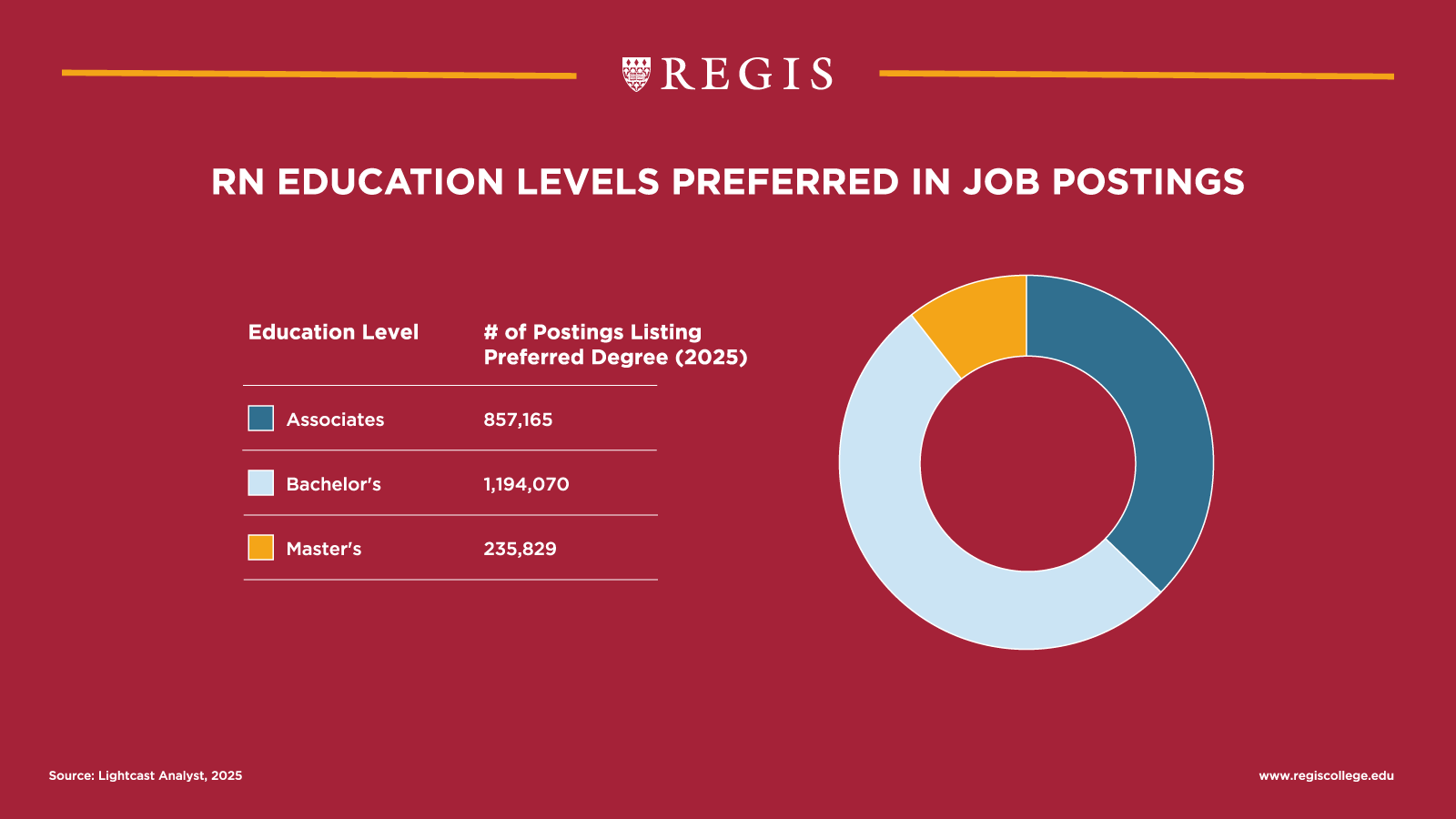
Accelerated BSN programs are designed specifically for people who already hold a bachelor’s degree in another field but want to pursue nursing. Instead of starting from scratch in a traditional four-year program, ABSN students build on their previous academic experience and complete nursing coursework in an intensive, condensed timeline.
According to Sharon Higgins, DNP, NP-C, ONC, WCC, Dean of the School of Nursing at Regis College, ABSN students come from a wide range of backgrounds—healthcare-adjacent roles like EMT or CNA, technical and engineering fields, education, business, and even recent college graduates who quickly determine that nursing is the pathway they should have chosen in the first place.
What unites them is the desire for:
- A faster route to a stable, high-demand career
- Upward mobility and specialization options
- Work that makes a direct impact
- Long-term job security
But accelerated programs aren’t easy. As Higgins explains, students must be prepared for a “rigorous” academic environment that requires strong time-management skills and the ability to adapt to objectively tested, science-driven material. Yet the payoff—completing nursing education far faster than the four years required in a traditional BSN program—is deemed worthwhile by most graduates.
What Are the Career Outcomes for ABSN Graduates?
Career outcomes are often the most important factor for those considering whether to enroll in an ABSN. While every individual's path is unique, accelerated nursing graduates consistently benefit from several strong, measurable advantages.
1. Strong Employment Prospects Nationwide
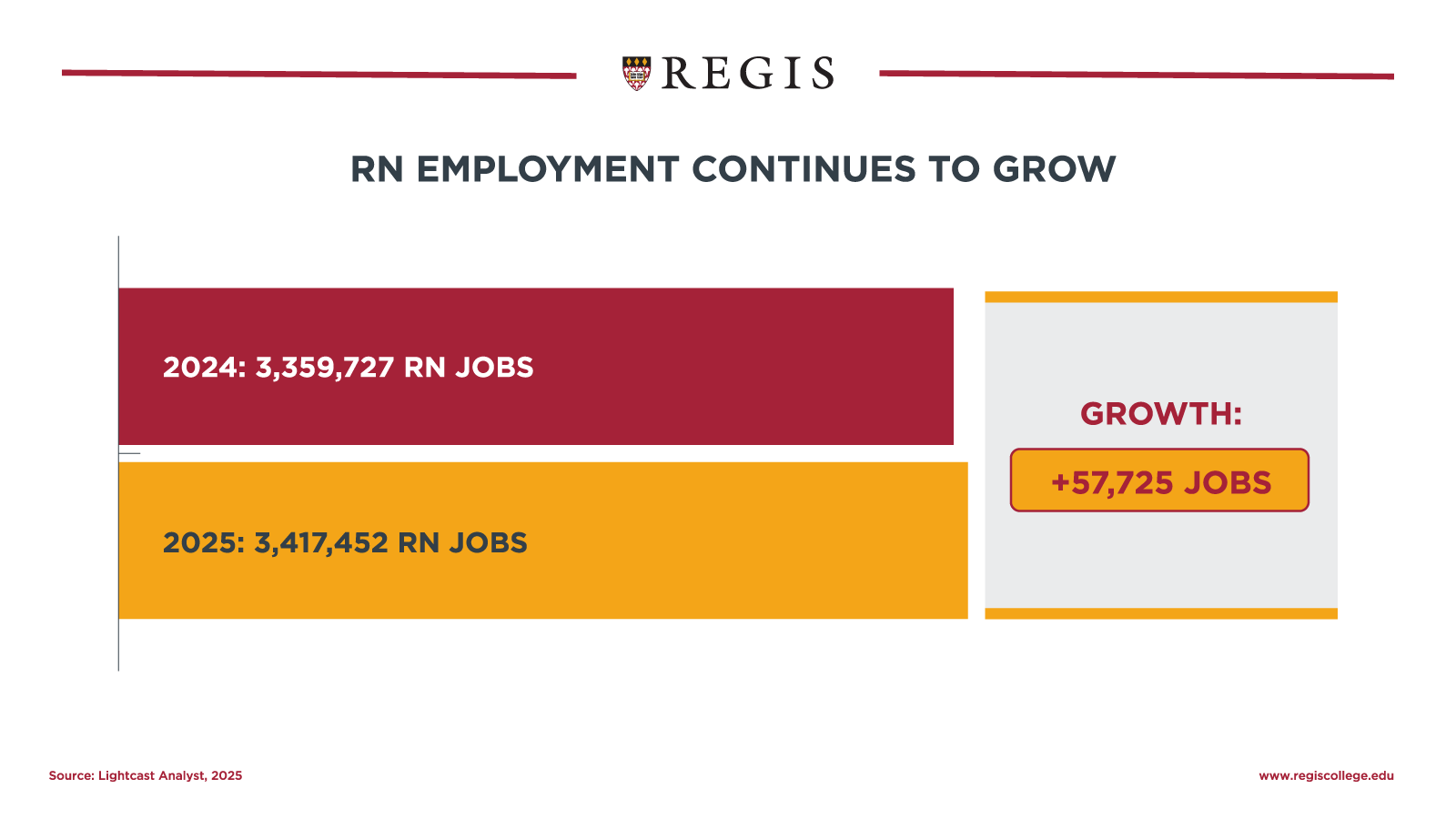
There remains a clear and enduring demand for registered nurses across the country. U.S. Bureau of Labor Statistics projects continued growth for the nursing profession, driven by:
- An aging population
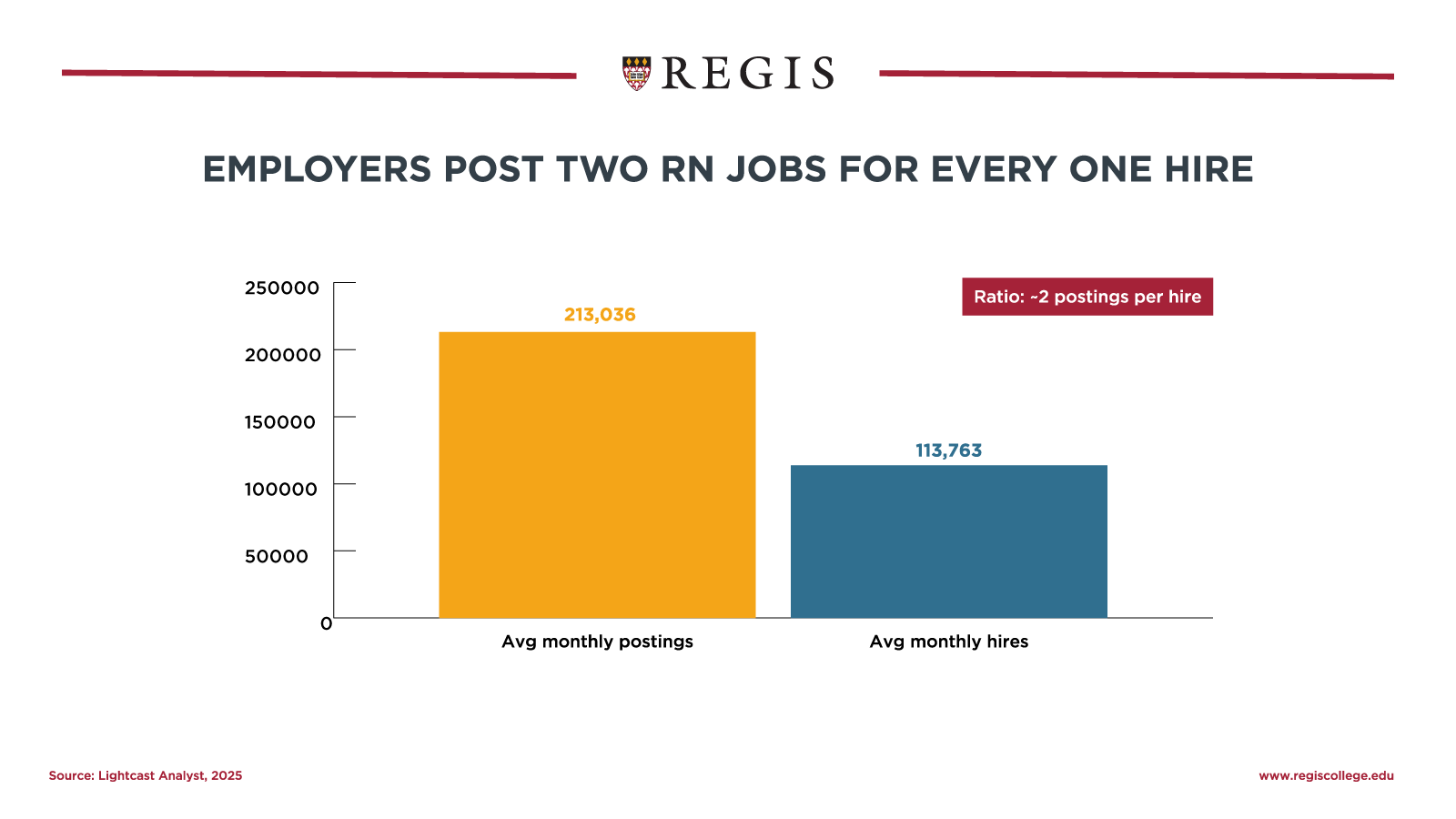
- Ongoing workforce shortages
- Expansion of outpatient and community-based care
- Increased need for specialized services
This demand provides new nurses with geographic flexibility and long-term job security. Whether graduates remain in their current state or relocate, the RN credential opens doors in hospitals, clinics, community health, long-term care, and specialized areas of practice.
2. Competitive RN Salaries and Long-Term Earning Potential
The return on investment for an ABSN becomes especially clear when considering salary. According to national BLS data:
- Entry-level RNs commonly earn between $60,000–$75,000, depending on region and employer type
- The national median RN salary (2024) is $93,600
- Experienced nurses and those in specialty areas can earn well above six figures
Compared to many bachelor’s-level career paths, and especially compared to fields experiencing stagnation, the financial trajectory for nurses remains exceedingly durable.
Wondering Which Path Fits Your Goals?
Compare our accelerated nursing programs at a glance.

3. Ability to Specialize Quickly
A decade ago, new graduates often needed years of experience before entering high-acuity units like the ICU, ER, or pediatrics. That’s no longer the case.
Higgins notes that today’s ABSN graduates are often able to move directly into specialty areas due to workforce demand. This means the ABSN not only speeds your entry into the field, but it can also accelerate your start in the type of nursing you want to pursue.
Common early-career roles for ABSN graduates include:
- Emergency department RN
- ICU RN
- Pediatric RN
- Maternity/postpartum RN
- Surgical/OR RN
- Medical-surgical RN
4. Clear Advancement Pathways
Nursing offers one of the most flexible career ladders in healthcare. After gaining experience, ABSN graduates can pursue:
- Nurse Practitioner (NP) roles
- Clinical Nurse Leader (CNL) positions
- Nurse management or administrative leadership
- Nurse educator positions
- Public health or community-based specialties
As Higgins describes it, nursing is a career where “there’s always a pathway… people are not stuck.” The ABSN is simply the first, accelerated step onto that ladder.
What Makes an ABSN Worth It? Key Factors to Consider
As you evaluate whether an ABSN is a smart investment, here are the factors that matter most.
1. Your Motivation and Career Goals
If you’re looking for:
- A stable, flexible, long-term career
- High earning potential
- Work that makes a visible difference
- Opportunities for graduate school or specialization
…then nursing offers one of the strongest returns on investment of any second-career pathway.
Higgins describes nursing as a field with “so many options for people to do… or different paths you can take.” From bedside care to advanced practice to leadership and education, the career ladder is long and highly customizable.
2. The Rigor and Pace of the Program
ABSN programs, by design, are intense. Students must balance:
- Science-heavy coursework
- Labs
- Simulations
- Clinical rotations
Those who succeed typically have:
- Strong time-management skills
- The ability to study efficiently
- The discipline to balance academic and personal commitments
As Higgins notes, many ABSN students succeed precisely because they’ve already “figured out how to study” from their first bachelor’s degree, giving them a leg up.
3. The Strength of Clinical Partnerships
Clinical experience is where theoretical knowledge transforms into real-world readiness. Top programs partner with respected hospitals, allowing students to:
- Build confidence through real patient care
- Work with experienced preceptors
- Gain exposure to multiple specialty areas
- Network with potential employers
Regis’ clinical placements across major Boston hospitals offer exactly this type of high-value experience.
4. Licensure and Employment Outcomes
Look for answers to questions like:
- How many students complete the program?
- What are the NCLEX pass rates?
- Where are graduates employed?
- Are they securing jobs right after graduation?
Higgins underscores that these outcome metrics are essential for evaluating any program. High pass rates and strong employer partnerships are signs that the program genuinely prepares students for success.
Why Regis College Stands Out in the ABSN Landscape
Regis College’s ABSN program directly supports student success and long-term outcomes, specifically because they provide:
1. A Proven Record of Student Success and NCLEX Excellence
Regis consistently reports strong NCLEX-RN pass rates at around 94%, according to recent program data. This reflects the program’s academic rigor, faculty expertise, and the support systems in place to help students transition confidently into practice.
Regis’ commitment to student preparation was recently recognized publicly as well, as the #1 Accelerated BSN Program in Massachusetts for 2026, citing program quality, licensure outcomes, and academic strength.
2. Accelerated Pathway to Fit Your Schedule
A 16-month campus-based track for students ready for full-time, immersive study.
This option delivers a curriculum, clinical experiences, and preparation for RN licensure, allowing students to choose a structure that aligns with their lifestyle and goals.
3. Deep, Long-Standing Ties to Greater Boston’s Healthcare Community
Though ABSN graduates can work anywhere in the country, Regis' location and partnerships give students a significant advantage if they want to begin their career in a major healthcare hub.
Students complete clinical rotations at some of New England’s most respected hospitals, often including:
- Mass General Brigham hospitals
- Beth Israel Lahey Health
- Newton-Wellesley Hospital
- Boston Children’s Hospital
- UMass Memorial (central and western MA)
Higgins notes that preceptorships—where students work one-on-one with a practicing nurse—often lead directly to a job offer upon graduation.
In addition, statistics show that Massachusetts is a strong location for RNs starting or continuing a career:
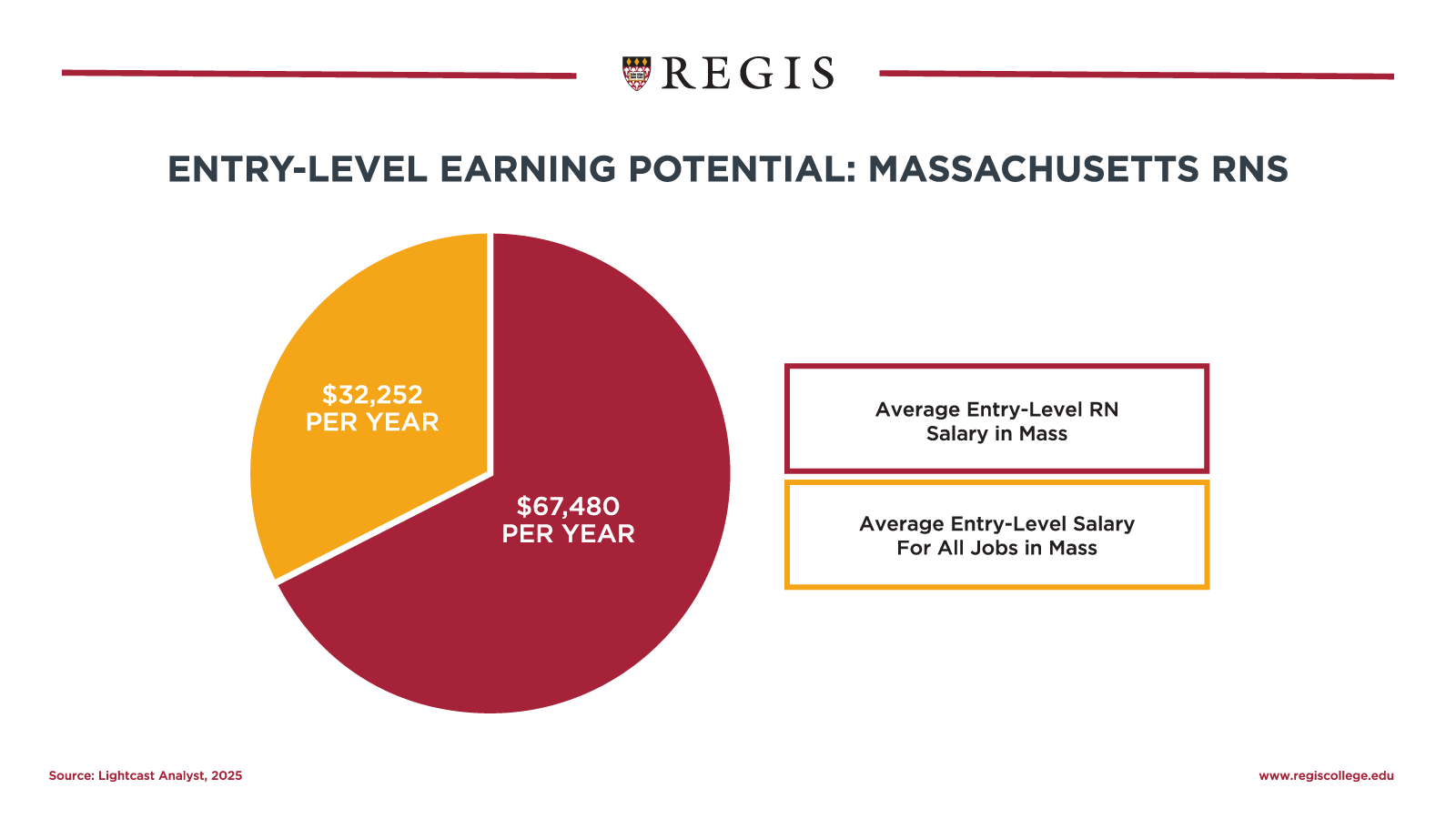
- Entry-level RN salaries in MA average around $67,000
- Statewide average RN salaries exceed $104,000 annually
- Job growth for RNs remains strong due to ongoing workforce shortages
4. A Mission-Driven Community Grounded in Support and Professionalism
Regis is known for its supportive, student-centered approach. Faculty bring decades of professional experience to the classroom and labs, and Higgins describes the culture as one that prepares graduates not only with clinical skill but with integrity, compassion, and professionalism.
So, Is the ABSN Worth It?
If you already hold a bachelor’s degree and want a meaningful, stable, and well-compensated career, an ABSN is one of the most efficient and impactful ways to enter the nursing profession.
A high-quality ABSN program offers:
- Fast-track entry into a rewarding field
- Strong job security and salaries
- Preparation for diverse clinical specialties
- Opportunities for graduate education and advancement
When evaluating programs, look closely at outcomes, clinical partnerships, faculty expertise, and flexibility options.
For many career changers, programs like the 16-month ABSN Track at Regis College deliver a compelling combination of speed, quality, and long-term value. With strong NCLEX performance, extensive Boston-area clinical placements, and flexible pathways designed for different life situations, Regis offers a proven route into a respected and in-demand profession.
If you’re ready to learn more or want help mapping out your next steps, Regis offers several ways to get started. Taking the first step can bring you closer to a rewarding new career in nursing—and Regis is here to support you throughout the journey.

Published Date