
If you already hold a bachelor’s degree and are considering a move into nursing, you’ve likely discovered there’s more than one way to earn a Bachelor of Science in Nursing (BSN). That flexibility can be empowering, but it can also raise an important question:
Should I pursue an accelerated BSN, or return to school for a more traditional BSN program?
Both pathways can lead to the same destination: a BSN degree, eligibility to sit for the NCLEX-RN, and entry into a rewarding, in-demand profession. But for career changers, the experience of getting there, including timeline, structure, prerequisites, and pacing, can look very different.
Below, we’ll dive into the differences between the two tracks, exploring expected timeline, who will excel in an accelerated as opposed to traditional BSN format, and what questions you should be asking before making a final decision. And we’ll explore how Regis College’s ABSN program provides the kind of flexibility and rigorous coursework that can set prospective students on a path towards a nursing career sooner rather than later.
Key Takeaways
- Both accelerated and traditional BSN programs lead to RN licensure, but they are designed for different student backgrounds, timelines, and learning needs.
- If you already have a bachelor’s degree, an Accelerated BSN (ABSN) is often the more efficient path because it builds on prior education instead of repeating general coursework.
- Traditional BSN programs are typically structured for first-degree students and, even with transfer credits, may extend the time to licensure for career changers.
- ABSN programs require prerequisites upfront and move quickly into nursing coursework, making them ideal for motivated adult learners prepared for an intensive academic experience.
- Regis College offers a 16-month ABSN option allowing career changers to emerge with a degree in a little over a year.
The Difference Between ABSN and Traditional BSN Programs
At a surface level, both traditional BSN and Accelerated BSN (ABSN) programs lead to the same credential and licensure eligibility. The distinction is not about outcomes or quality but, rather, who the program is designed for and how the curriculum is organized.
A traditional BSN program is primarily structured for students earning their first bachelor’s degree. Coursework typically includes:
- General education requirements
- Foundational science courses
- Upper-division nursing coursework and clinical rotations
This model provides a gradual academic ramp-up and integrates prerequisite coursework into the overall program flow.
An ABSN, by contrast, is intentionally designed for students who already hold a bachelor’s degree in another field. Because general education requirements are already complete, ABSN programs focus almost entirely on nursing coursework and clinical preparation from the start. The curriculum is condensed, immersive, and highly structured.
Both paths are rigorous. Both prepare students for professional nursing practice. The difference lies in where students are starting and how efficiently they want to move forward.
Is a Traditional BSN an Option for Someone With a Degree?
Yes.
Students who already hold a bachelor’s degree can pursue a traditional BSN, and many programs will accept transfer credits from prior coursework. Such students will likely not have to worry about “starting from scratch.”
However, how those credits apply varies by institution. In many traditional BSN programs:
- General education credits may transfer
- Certain science prerequisites may still need to be completed
- Students often progress through a fixed, multi-year sequence designed for first-degree learners
Even with transfer credits, second-degree students in traditional programs may spend additional semesters completing prerequisites and waiting to enter upper-division nursing coursework.
This doesn’t make the traditional path wrong but it can mean a longer timeline to licensure compared to programs designed specifically for second-degree students.
Wondering Which Path Fits Your Goals?
Compare our accelerated nursing programs at a glance.

How ABSN Programs Handle Prior Coursework and Prerequisites
ABSN programs approach prior education differently. Rather than folding prerequisites into the program itself, accelerated programs typically require students to complete specific foundational science courses before enrollment. This ensures that all students begin the program ready for an intensive nursing curriculum.
At Regis College, the 16-month ABSN program is designed for students who already hold a non-nursing bachelor’s degree and have completed required prerequisites. Once admitted, students move directly into a 60-credit nursing curriculum focused on clinical knowledge, patient care, and professional practice.
For prospective students, this structure often means:
- Less repetition of non-nursing coursework
- Earlier immersion in nursing concepts
- A clearer, more predictable academic timeline
What the Timeline Really Represents: Pace, Structure, and Flexibility
When comparing programs, it’s tempting to focus only on how long each option takes. But for career changers, the more meaningful question is what that time looks like in practice.
Traditional BSN: A Longer, Developmental Model
Traditional BSN programs are intentionally paced to allow students to:
- Build academic and clinical confidence over time
- Complete prerequisites alongside general education
- Progress gradually into advanced nursing coursework
For students who prefer a slower pace or who want more time to re-acclimate to academics, this structure can be appealing even if it extends the overall timeline.
ABSN: A Focused, Immersive Model
Accelerated programs compress that same nursing curriculum into a shorter timeframe by:
- Eliminating general education coursework
- Reducing gaps between semesters
- Maintaining a consistent, high-intensity pace
At Regis College, the 16-Month ABSN (On-Campus) format offers a full-time, immersive option designed for students who can prioritize nursing school as their primary focus and want to enter the workforce as quickly as possible.
Sharon Higgins, DNP, NP-C, ONC, WCC, Dean of the School of Nursing at Regis College, explains what students can expect from the accelerated experience: “The 16-month program is very intensive. Most students aren’t able to work because school really becomes their full-time commitment.”
Do Outcomes Differ Between Accelerated and Traditional BSN Programs?
In terms of licensure and professional scope, the answer is simple: no.
Graduates of both traditional BSN and ABSN programs:
- Earn a BSN degree
- Are eligible to sit for the NCLEX-RN
- Enter practice as registered nurses
An RN is an RN.
Where differences can emerge is in how students are prepared for practice, which often reflects program design rather than program length.
Research comparing accelerated and traditional BSN students has shown that ABSN graduates perform on par with, and in some cases better than, traditional students on the NCLEX-RN, reinforcing that an accelerated timeline does not mean reduced preparedness.
What Sets the Regis ABSN Program Apart for Career Changers
Accelerated nursing programs are not all the same. For students returning to school after earning a previous degree, program design, clinical preparation, and faculty experience matter — especially when the timeline is condensed.
The Regis College ABSN program—named the #1 program in Massachusetts for 2026—is built specifically for career changers who want to enter nursing practice feeling confident, prepared, and supported, not rushed. “With every clinical course, students have three components — classroom learning, simulation lab, and clinical experience,” explains Higgins. “That structure gives them the opportunity to build skills in a controlled environment before stepping into real patient care.”
Key elements that distinguish the Regis ABSN experience include:
A Curriculum Designed for Second-Degree Students
The ABSN program at Regis follows a 60-credit nursing curriculum, ensuring consistent academic rigor. Because students enter with a completed bachelor’s degree and required prerequisites, the program focuses immediately on nursing knowledge, clinical reasoning, and professional practice, without unnecessary repetition.
Experienced Faculty with Real-World Perspective
Regis nursing students learn from experienced faculty, 90% of whom are industry-active nurses. This practical perspective helps bridge the gap between theory and real-world scenarios, preparing students for what modern healthcare settings look like.
Hands-On Learning Through Simulation and Clinical Placement
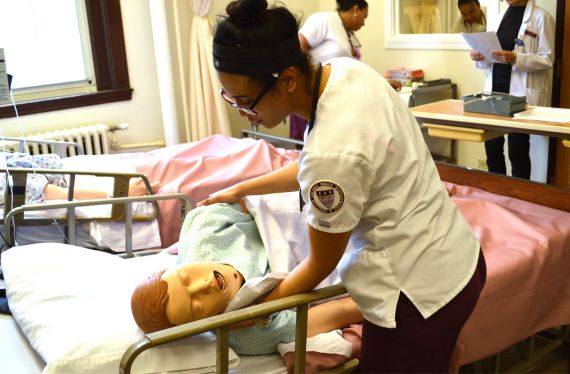
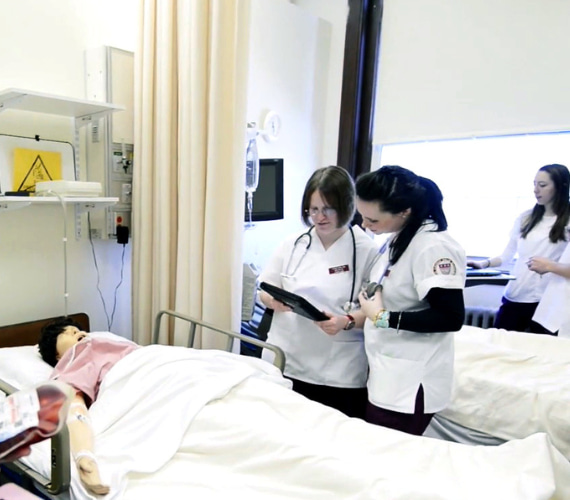
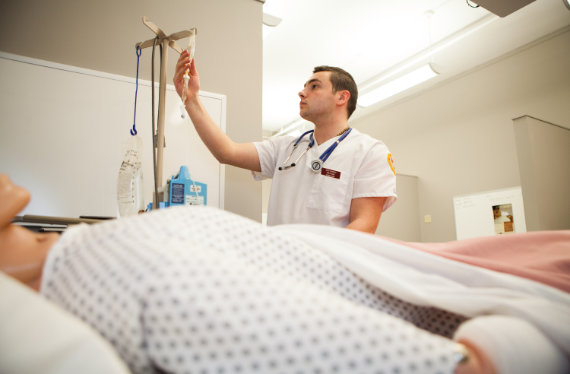
Students train in simulation labs before entering clinical environments, allowing them to develop skills and confidence in a structured, supportive setting. Clinical placements span leading hospitals and healthcare facilities throughout Greater Boston, giving students exposure to a wide range of patient populations and care settings.
A Preceptorship That Supports the Transition to Practice
In the final phase of the program, students complete a preceptorship that pairs them one-on-one with a practicing registered nurse. This immersive experience allows students to function as part of the care team and often serves as a bridge to employment after graduation.
Key Questions to Ask Before Choosing Your Path
If you already have a bachelor’s degree and are deciding between an accelerated and traditional BSN, these questions can help clarify which option aligns best with your goals.
1. How quickly do I want to enter the nursing workforce?
Accelerated programs allow many career changers to begin earning an RN salary sooner, an important consideration when weighing opportunity cost.
2. Can I commit to an intensive academic schedule?
ABSN programs move quickly and demand sustained focus. Students who thrive in immersive environments often find this structure motivating.
3. Do I already have (or can I complete) the required sciences before starting?
Accelerated BSN programs typically require foundational science courses to be completed before enrollment so students can move quickly into nursing coursework. Traditional BSN programs often include these sciences within the program itself. If you already have — or can complete — the required prerequisites, an ABSN may offer a more streamlined path.
4. Do I need flexibility to balance work or family responsibilities?
A hybrid or extended ABSN track may offer a middle ground between speed and flexibility.
5. What learning environment helps me succeed?
Some students prefer a longer runway. Others benefit from momentum and structure. Knowing how you learn best matters as much as knowing your end goal.
So, Which Path Is Right for You?
If you already hold a bachelor’s degree and are ready to transition into nursing, both accelerated and traditional BSN programs can lead to the same destination. The best choice depends on how you want to get there.
For many career changers, an Accelerated BSN offers a focused, efficient pathway designed around prior academic experience and adult learners’ needs. For others, a traditional BSN’s longer timeline and pacing may feel like a better fit.
If you’re exploring your options and want help determining which path aligns with your goals, Regis College provides resources to help you take the next step with confidence.

Published Date