
Choosing the right master’s program in Occupational Therapy is one of the most important decisions you’ll make for your long-term career. With exceptional employment opportunities available to graduates—projections show about 14% job growth from 2024–2034—occupational therapy is expanding faster than the average for all occupations.
Which educational pathway you choose is paramount in determining whether you take full advantage of those opportunities. The Master of Science in Occupational Therapy (MSOT) at Regis College, for instance, is designed as an immersive, full-time program that prepares you to improve quality of life and functional independence for clients of all ages. Students learn to evaluate, integrate, and apply OT principles in both classroom and community settings through labs, service learning, and fieldwork.
Here, we’ll explore what OT hiring managers value most in entry-level therapists, and how the Regis MSOT program intentionally builds those skills from day one.
Key Takeaways
- Employers value MSOT graduates who are adaptable, empathic, and strong critical thinkers, qualities Regis deliberately builds through lab-intensive coursework, early hands-on practice, and extensive fieldwork guided by actively practicing faculty.
- Regis prepares students to succeed in any OT setting, from hospitals and schools to community-based, mental health, and emerging practice areas, thanks to diverse placements and a curriculum grounded in evidence-based, client-centered practice.
- The program emphasizes professional identity, confidence, and clinical reasoning, ensuring graduates can justify treatment decisions, collaborate across healthcare teams, and respond effectively to new or unpredictable clinical challenges.
- Regis MSOT students benefit from small cohorts, personalized support, and strong outcomes, including high NBCOT pass rates, strong job readiness, and a faster path to entering the workforce compared to many doctoral programs.
What OT Hiring Managers Really Want
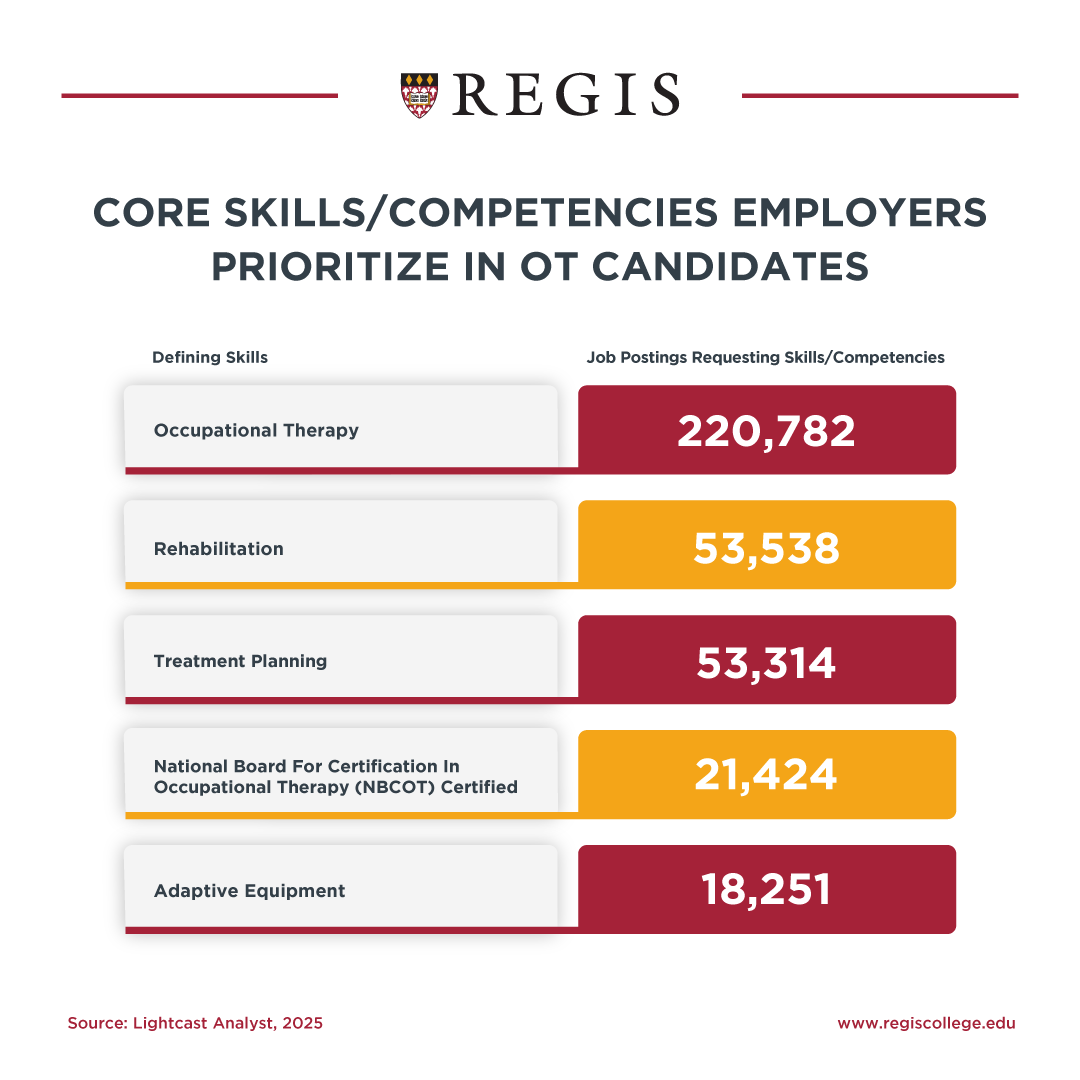
When employers evaluate new occupational therapists, they’re looking beyond a transcript. They want clinicians who are adaptable, empathic, evidence-based, and ready to collaborate across teams and settings.
According to Dr. Michael Roberts, Associate Professor in the MSOT program, Regis graduates excel because they’re “client-centered rather than following a ‘recipe book’ of what to do according to different diagnoses,’” and always ask what specific clients need and what occupations are most meaningful to them.
Here are the qualities most employers prioritize.
Adaptability and Problem-Solving
OT practice is changing quickly. New technologies, population health initiatives, and shifting care models require therapists who can adapt.
Roberts says Regis takes pride in the fact that “students can be dropped into any situation and…find a way to help people in that situation.” That level of adaptability is invaluable for employers who need therapists comfortable with:
- Complex or unpredictable cases
- Non-traditional practice settings
- Limited resources or equipment
- Emerging diagnoses and conditions
Roberts provides a clear example: a Regis alum who applied for a physical therapist position. However, after interviewing, she explained to clinic leadership her belief that what the facility really needed was an OT to build a postpartum pelvic floor program. The organization agreed, and they hired her to do exactly that.
Empathy and Emotional Intelligence
Occupational therapy is deeply relational. Employers expect new grads to demonstrate:
- Genuine empathy for clients and families
- Emotional intelligence in challenging situations
- Respect for diverse backgrounds and lived experiences
These aren’t left to chance at Regis. Roberts notes that the program explicitly teaches empathy, emotional intelligence, and communication skills in class, rather than assuming students will “just pick them up” during fieldwork.
Evidence-Based Clinical Reasoning
Hiring managers want clinicians who can justify their recommendations to clients, families, payers, and interprofessional teams.
Regis students learn to:
- Use evidence-based practice to guide treatment decisions
- Critically appraise research literature
- Connect course content to clinical reasoning through courses like Clinical Reasoning in Occupational Therapy and Research Methods
Roberts emphasizes that students are expected to “look at the best available information…to inform and justify anything they recommend to stakeholders.”
Strong Communication and Interprofessional Collaboration
Modern OT practice is highly collaborative. OTs regularly partner with nurses, PTs, SLPs, physicians, social workers, and teachers.
Regis builds this teamwork muscle through:
- Group projects and partner exams
- Interdisciplinary discussions
- Feedback-rich lab courses
The result: graduates who can communicate clearly, advocate for their clients, and function as effective members of interprofessional teams from day one.
Client-Centered, Holistic Care
Employers don’t want technicians who simply run through a checklist of exercises. They want therapists who understand how occupations—meaningful everyday activities—shape identity, roles, and quality of life.
Roberts describes occupation as the profession’s “most important and impactful modality,” and notes that Regis students graduate with a kind of “zealotry of the converted about how magical and powerful our profession is.”
Wondering If Occupational Therapy Is Right For You?
Download our free guide to gain insights about the career!

The Future of OT: How Regis Prepares Graduates for an Evolving Profession
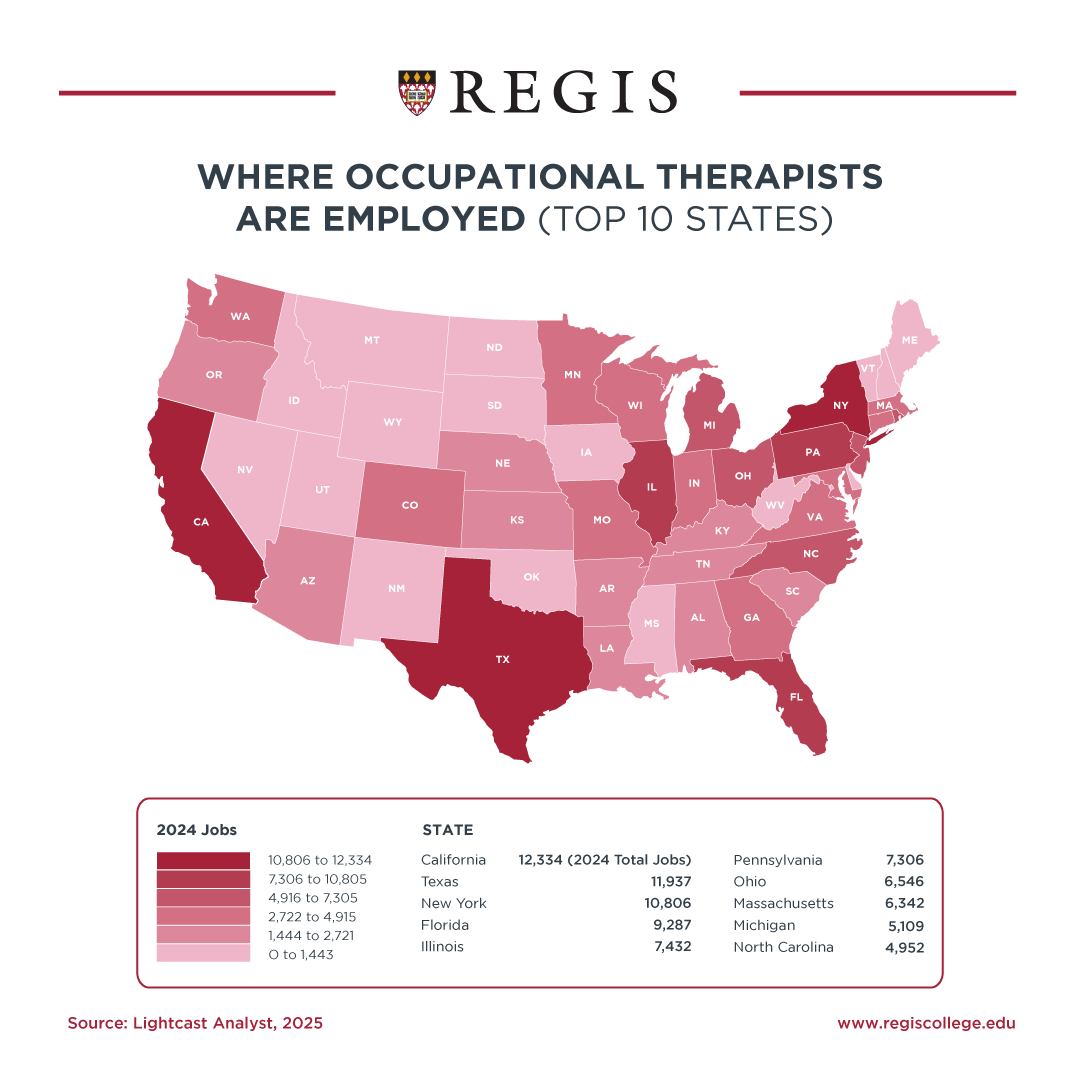
Occupational therapy is changing quickly as healthcare shifts toward community-based care, population health, and technology-integrated practice. The U.S. Bureau of Labor Statistics notes that OTs increasingly work not only in hospitals and schools but also in primary care, home health, and community-centered settings—areas projected to continue expanding.
Regis prepares students for this evolving landscape by helping them think beyond traditional roles. Courses like Community-Based Practice/Lab teach students to:
- Evaluate the needs of communities (not just individuals)
- Design population-level programs
- Understand how policy, access, and environment shape health
At the same time, the profession is being reshaped by emerging tools such as virtual and augmented reality, driving simulators, and advanced assistive technology. Regis integrates these innovations thoughtfully, training students to critically evaluate technology, understand when it enhances practice, and recognize when human empathy and clinical reasoning are still irreplaceable.
Roberts emphasizes that new therapists must be ready for challenges we can’t fully predict yet. As he explains: “Tell me the treatment plan for someone who has had Long COVID for 10 years…we don’t know yet. But you might have to treat it.”
To prepare students for these unknowns, Regis focuses on flexible thinking, strong clinical reasoning, and the ability to adapt interventions to real-world circumstances.
This forward-looking approach is also central to how the program builds professional identity and confidence. As Roberts puts it: “We’re building the foundation. If they want to put a shack on it, great. They want to put a castle on it, awesome.”
Through intensive labs, diverse fieldwork placements, mentorship from actively practicing faculty, and a strong emphasis on occupation and identity, students graduate confident in their ability to navigate new situations, new technologies, and new practice areas.
These strengths contribute to Regis’ exceptional outcomes, including a 95% NBCOT pass rate since 2018 and a 99% graduation rate across the 2022–2024 cohorts.
How Regis Prepares Students for These Expectations
The qualities employers value are intentionally built into the Regis MSOT structure and teaching philosophy.
1. Faculty Who Are Actively Practicing Clinicians
Many programs have faculty who no longer see clients. At Regis, all full-time MSOT faculty are practicing OTs, working in settings such as pediatrics, home care, hand therapy, and adult rehab.
That means:
- Examples in class come from cases actually, and often recently, experienced, not just from textbooks.
- Students learn assessment tools and interventions that faculty are actively using with their own caseloads.
- The curriculum can adapt quickly to changes in practice.
As Roberts describes, in lab courses faculty can say, “We’re using this assessment in class because I used this assessment yesterday with a client and here’s what happened.”
2. A Lab-Heavy, Hands-On Curriculum
About half of MSOT courses at Regis have a lab component, giving students extensive hands-on practice with real equipment and real-life scenarios.
Within the first few weeks, students are already being evaluated on:
- Safe transfers
- Adaptive dressing techniques
- Standardized assessments
- Functional task analysis
You can see this emphasis through lab-based courses like OT Practice in Physical Dysfunction/Lab and Group Dynamics/Lab.
This immersive learning model builds confidence long before Level II fieldwork, which employers notice when new grads step into their first jobs.
3. Diverse Fieldwork in Traditional and Emerging Practice Areas
Fieldwork is where everything comes together. According to AOTA and ACOTE standards, accredited OT programs must provide at least 24 weeks of full-time Level II fieldwork to prepare students for entry-level practice.
Regis meets—and in many ways exceeds—these expectations:
- Level I fieldwork is integrated throughout the curriculum (via courses like Fieldwork IA/IB) to give students early exposure to practice settings.
- Level II fieldwork consists of two full-time placements totaling 24 weeks (e.g., hospitals, school systems, outpatient clinics, and non-traditional settings like adapted sports and community-based mental health).
The program highlights this breadth: students “complete fieldwork in just about every OT practice setting, from large hospitals to school systems to outpatient practices, to non-traditional sites like community-based mental health and adapted sports,” according to Regis’ description.
4. Small Cohorts and Personalized Support
Regis intentionally keeps MSOT cohorts small to ensure:
- Close relationships with faculty
- Customized academic and professional advising
- Personalized fieldwork placement decisions
Because Roberts personally interviews every applicant, he can understand each student’s background, strengths, and challenges, and use that insight later when recommending placements and supporting their progression.
He notes that if a student had a rough undergraduate year due to family responsibilities (such as caring for a grandparent in hospice), that lived experience can actually make them more attractive as a candidate because it deepens their empathy and understanding of caregivers.
5. Intentional Focus on Professional Identity and Reasoning
Regis doesn’t simply teach students to perform techniques; it helps them think and act like occupational therapists.
Students engage with:
- A dedicated Clinical Reasoning in Occupational Therapy course
- The Intentional Relationship Model, which trains students to adapt their interpersonal style based on what each client needs
- Leadership and advocacy content in OT Leadership and Special Topics in OT
Roberts explains that this emphasis differentiates practitioners from technicians: the goal isn’t to be a ‘computer’ that just ‘drops in three data points and spits out an answer,’ but to integrate evidence, empathy, and context so clinicians are truly meeting clients where they are.
Five Questions Prospective Students Should Ask Themselves
Before choosing an MSOT program, ask yourself:
1. Do I learn best through hands-on experience?
If you prefer learning by doing, a lab-heavy curriculum like Regis’—where nearly half the courses include labs and early practical exams—is a strong fit.
2. Do I want faculty who still practice in the field?
Regis’ MSOT faculty actively work as OTs in pediatrics, home care, hand therapy, and more, bringing real-time clinical insights into the classroom.
3. Am I looking for a close-knit cohort and personalized support?
Small class sizes mean individualized mentoring and tailored fieldwork matching—something that can significantly influence your early career trajectory.
4. Do I want to start working (and earning) sooner?
Regis offers two program entry points:
- A two-year fall start path
- A two-and-a-half-year spring start path with a summer break for work or family commitments
5. Do I want to be prepared for any OT specialty or setting?
Regis trains students as well-prepared generalists who can go into hospitals, schools, outpatient clinics, community agencies, or emerging settings—and then grow into specialties over time.
Regis MSOT Graduates Are Trusted by Employers
Regis College has designed its MSOT program around the realities of modern occupational therapy, and the expectations of employers who hire new graduates. The curriculum is marked by:
- Active practitioner faculty
- A lab-heavy, hands-on curriculum
- Extensive fieldwork across diverse settings
- Small cohorts and personalized support
- A strong track record on graduation and NBCOT pass rates
That means Regis MSOT graduates emerge as adaptable, client-centered clinicians with the confidence and skills to thrive in a changing healthcare landscape.
If you’re ready to begin this next chapter in your professional career, reach out to our team today and learn more about Regis’ MSOT program.

Published Date