
Bedside nursing is one of the most important and demanding roles in healthcare.
For many nurses, direct patient care provides work that is meaningful, fast-paced, and deeply personal. It is where they build clinical judgment, develop confidence, advocate for patients, and see the impact of their work every day.
Yet, whether it be concerns over balancing 12-hour shifts with increased family responsibilities or the physical demands of the role, many nurses at some point begin to wonder what else is possible.
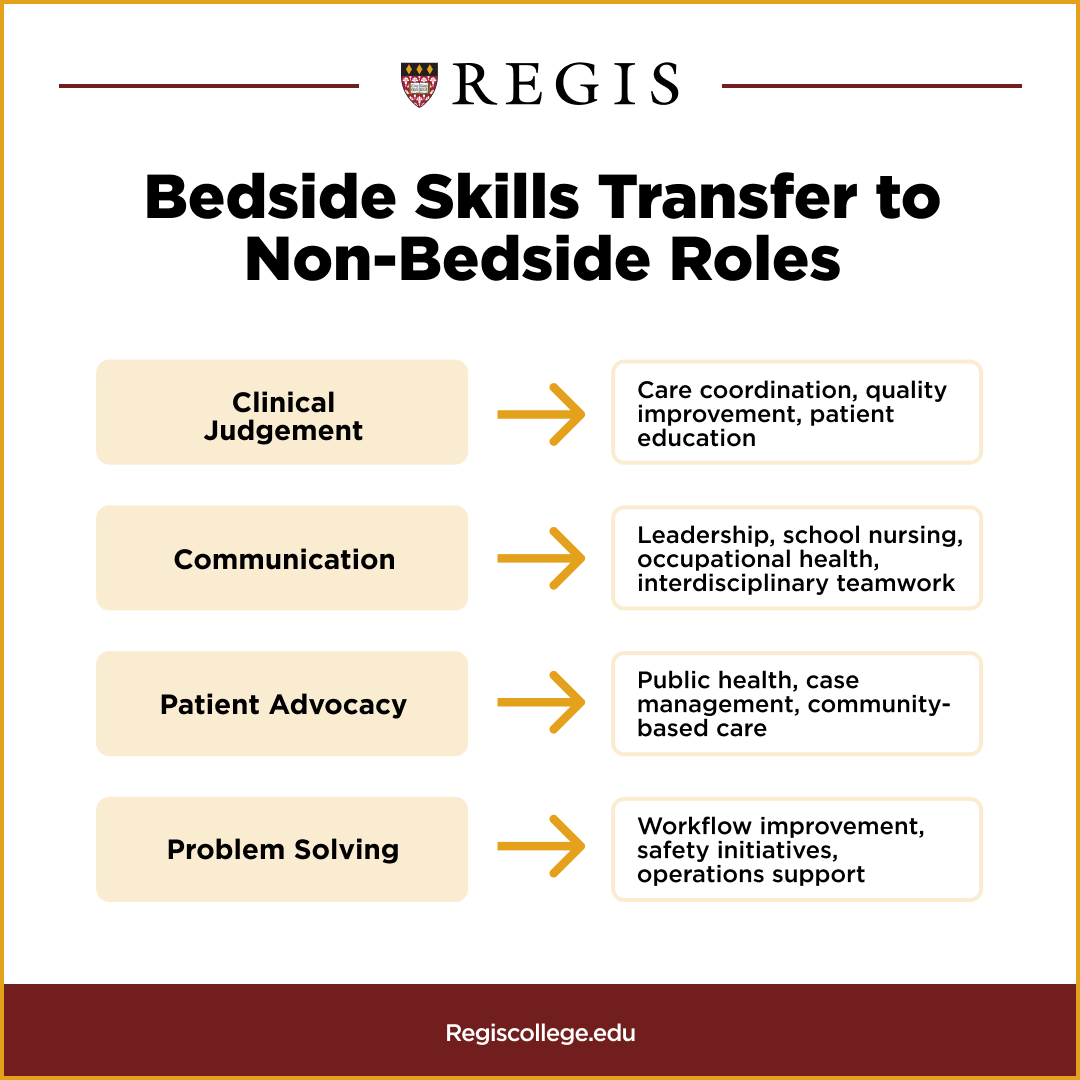
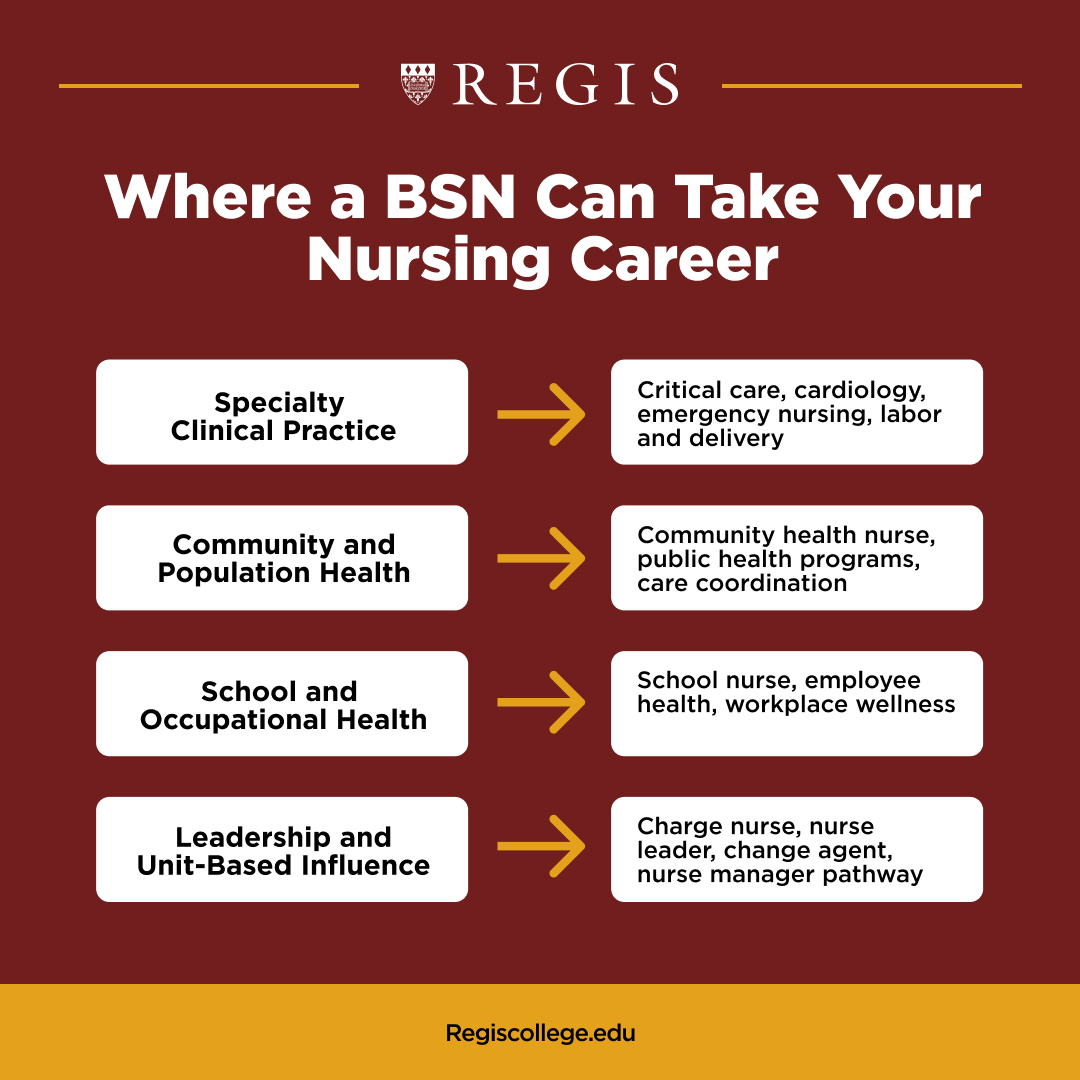
With a bachelor of science in nursing, registered nurses may be able to pursue career paths in other areas, from school nursing, occupational health, and public health, to care coordination, case management, and patient education. Some roles may require additional experience, certifications, state-specific credentials, or graduate education, but a BSN is usually the way nurses create the foundation for broader career mobility.
That’s why choosing the right degree program is so important, especially for practicing nurses who need to balance their current careers with furthering their education. Programs, such as Regis College’s BS in Nursing RN-to-BS Degree Completion program, that are designed for licensed registered nurses with an associate's degree who want to continue their education and expand their long-term options often provide the best launching pad for future success.
Key Takeaways
- A BSN can help nurses pursue opportunities beyond traditional bedside care, including leadership, community health, school nursing, occupational health, care coordination, education, specialty practice, and graduate study.
- “Beyond bedside” does not always mean leaving patient care entirely. It can also mean moving into specialty units, hybrid roles, teaching, coordination, or leadership.
- Some non-bedside roles may require additional experience, certification, or graduate education, but the BSN often serves as an important foundation.
- Salary varies widely by role, setting, region, experience, and education level. Nurses should view salary data as directional rather than guaranteed.
- Regis’ RN-to-BS program helps nurses build leadership, evidence-based practice, population health, and capstone project skills that can apply across many nursing settings.
Why Nurses Look for Career Options Beyond the Bedside
Considering options beyond bedside nursing does not mean a nurse is turning their back on patient care. It often means they are thinking realistically about a long career.
Nursing careers can last decades. The role that fits your life at 25 may not be the role that fits at 35, 45, or 55. Your interests may change, as will your abilities and responsibilities. The healthcare system will almost certainly change.
Deborah Roy, PhD, assistant professor and BS in Nursing RN-to-BS Degree Completion program director at Regis College, believes nurses should be thinking about that long-term flexibility early on in their careers.
“If you decide that…your body can’t handle (bedside nursing) anymore, and you want to go on to other things, then you’re going to need that BSN to make you more competitive,” Roy says. “And it may also be a requirement of the job.”
Roy describes nursing as a career with many possible directions.
“Good people who care, who want to advocate for folks can come in, gain skills, and they can have a profession for life,” she says. “And they can tailor that profession for what their needs are.”
That may mean staying close to direct care. It may mean moving into a specialty unit. It may mean working in a school, workplace, public health agency, home health organization, clinic, insurance company, quality improvement department, or graduate nursing pathway.
The value of the BSN is not that it pushes every nurse away from the bedside. It is that it can help nurses avoid being locked into only one version of nursing.
So, what options may be available to those searching for a new avenue to apply their nursing skills?
Ready To Start Your Nursing Journey?
Download our guide to find out which degree is right for you.

Nursing Leadership and Management Roles
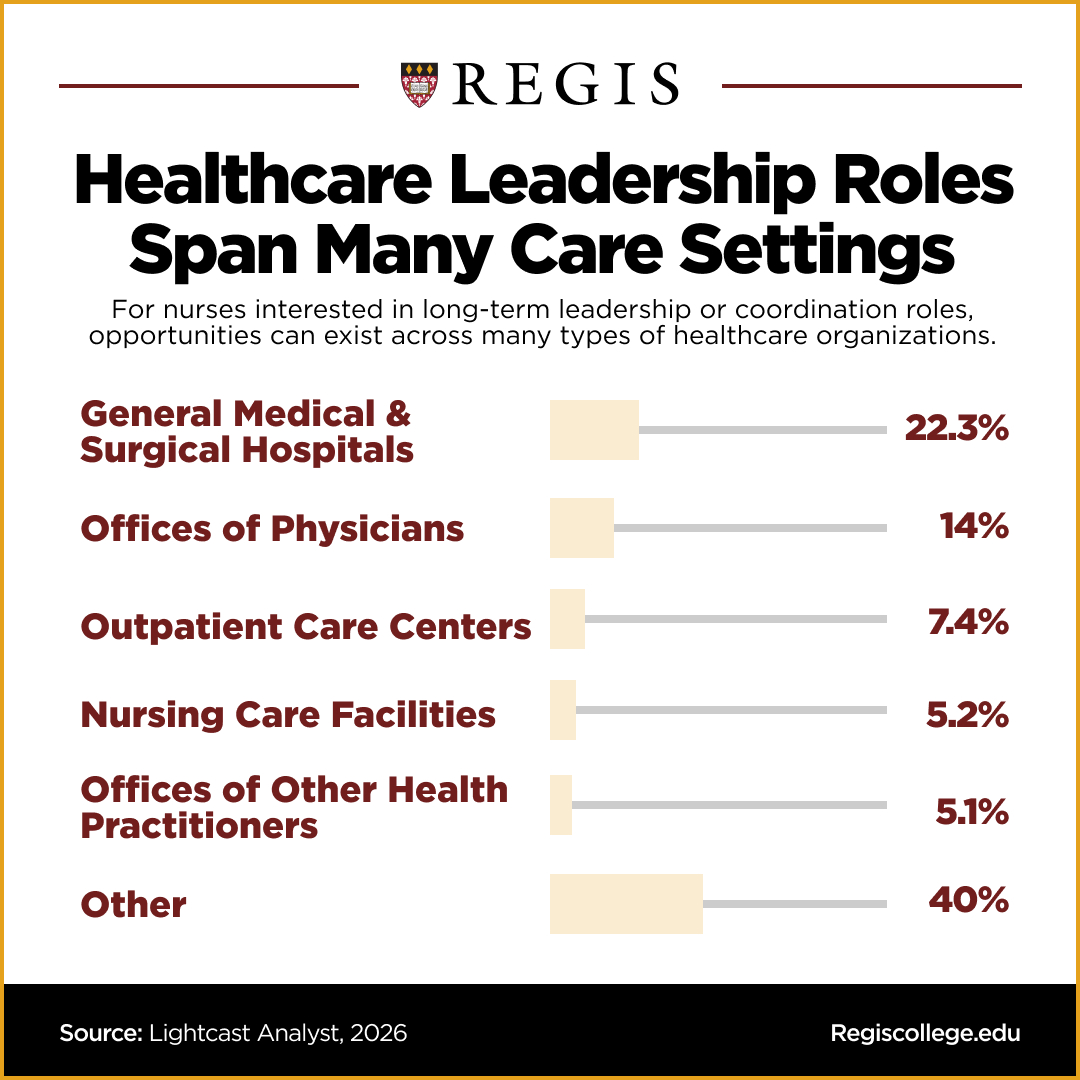
Leadership is one of the most common directions nurses consider when thinking beyond bedside care. However, leadership can mean more than becoming a nurse manager.
BSN-prepared nurses may pursue or prepare for roles such as:
- Charge nurse
- Assistant nurse manager
- Nurse manager
- Clinical coordinator
- Unit educator
- Preceptor
- Quality or patient-safety committee member
- Informal unit leader
- Change agent within a department or organization
Such leadership-focused roles now either strongly prefer or outright require a BSN, a reality Roy has seen influence students in the Regis program: a recent student returned to pursue her BSN after being offered a leadership position that was still clinically focused but required the credential.
For nurses who want formal management or administration, the salary potential can be different from bedside nursing, but so are the expectations. According to the U.S. Bureau of Labor Statistics (BLS), medical and health services managers had a median annual wage of $117,960 in May 2024, and employment in the field is projected to grow 23 percent from 2024 to 2034. However, these roles typically require healthcare work experience and may require education or experience beyond the BSN alone.
Even if you do not want a management title, leadership skills still matter. Nurses lead when they advocate for patients, communicate across teams, mentor newer nurses, solve problems, and help improve unit culture.
This is where BSN-level coursework can help. Regis’ RN-to-BS curriculum, for instance, includes Nursing Leadership and Transition to Professional Practice, along with coursework in evidence-informed nursing care, population health, healthcare systems, and a capstone project. Those experiences can help nurses connect the leadership they already practice to broader professional influence.
School Nursing
School nursing can be a strong fit for nurses who enjoy working with children, adolescents, families, educators, and communities.
School nurses may support:
- Student health assessments
- Medication administration
- Chronic condition management
- Emergency response
- Immunization compliance
- Health education
- Care coordination with families and providers
- Support for students with complex medical needs
The National Association of School Nurses describes those working in this sector as caregivers, advocates, educators, and problem-solvers who support student health, wellness, and academic success—work that will likely appeal to nurses who want a community-based role, a prevention-focused environment, or a schedule that differs from hospital shift work.
It still requires strong assessment, communication, documentation, and advocacy skills, but the setting and daily rhythm can look very different from inpatient bedside nursing.
Occupational Health Nursing
Occupational health nursing is another path for nurses who want to use clinical skills outside the hospital.
Occupational health nurses work with employees, employers, and workplace safety teams to support health, prevent injury, respond to workplace incidents, and promote wellness. These roles may exist in corporate settings, manufacturing, healthcare organizations, government agencies, universities, and other workplaces.
The American Association of Occupational Health Nurses says occupational health nurses help create and sustain safe workplaces by identifying risks, supporting compliance with regulatory standards, and evaluating workplace hazards. AAOHN also describes occupational and environmental health nursing as focused on health promotion, illness and injury prevention, restoration of health, and protection from work-related and environmental hazards.
Responsibilities in these areas may involve:
- Employee health screenings
- Workplace injury prevention
- Return-to-work planning
- Case management
- Health and wellness programming
- Compliance documentation
- Emergency response planning
- Education around workplace safety
- Collaboration with human resources or safety teams
For nurses who like assessment, education, documentation, prevention, and systems-level thinking, this can be a practical non-bedside option. A BSN can be helpful because occupational health roles often require nurses to think beyond individual care and consider workforce health, policy, communication, and organizational risk.
Community Health and Public Health Nursing
Community health and public health nursing allow nurses to focus on groups of people rather than only one patient assignment at a time.
These nurses may work in:
- Public health departments
- Community clinics
- Nonprofit organizations
- Home health organizations
- Outreach programs
- Maternal-child health programs
- Vaccination or prevention initiatives
- Chronic disease education programs
- Health equity or access-to-care initiatives
“What are the public health needs, and how do we start influencing public health? How do we put together a plan to address issues that might be on a unit or in an organization, in a community, or they might be nationwide?” says Roy, about these types of roles and the critical thinking skills a BSN-level education can help prepare nurses tackle.
Community and public health roles may include direct patient interaction, but they often involve prevention, education, resource connection, program planning, and outreach. This path may appeal to nurses who care deeply about health equity, chronic disease prevention, maternal-child health, older adults, or underserved communities.
Salary may vary depending on whether a role is classified as an RN position, public health role, community health position, or health education role. BLS reports that health education specialists had a median annual wage of $63,000 in May 2024.
Case Management and Care Coordination
Case management and care coordination can be natural fits for nurses who are strong communicators, patient advocates, and systems navigators.
In these roles, nurses may help patients move through complex healthcare systems by:
- Coordinating care plans
- Communicating with providers
- Educating patients and families
- Supporting transitions of care
- Connecting people with resources
These roles may exist in hospitals, insurance companies, accountable care organizations, home health agencies, outpatient clinics, rehabilitation settings, and community-based programs.
Case management and care coordination roles often require nurses to anticipate barriers, communicate clearly, document thoroughly, and help patients receive the right care at the right time.
“My personal biased opinion is that nursing is what has maintained and sustained the healthcare system through challenge,” says Roy, about nursing in general, including those involved in case management and care coordination. “I call us spackle, right? We fill holes, we bridge gaps, and we make it all look pretty.”
Specialty Nursing and Advanced Clinical Roles
“Beyond bedside” does not always mean leaving direct patient care. For some nurses, it means moving into a more specialized clinical role.
- Specialty areas may include:
- Critical care
- Emergency nursing
- Labor and delivery
- Cardiology
- Oncology
- Pediatrics
- Perioperative nursing
- Case-specific or procedure-focused care
- Specialty certification pathways
“There are many specialties that require the BSN,” Roy says. “So critical care, labor and delivery, a lot of emergency departments…some of the more technically challenging, knowledge-challenging areas are going to require the BSN.”
Specialty nursing can offer a different kind of career growth for nurses who want to remain close to patient care but develop deeper expertise. These paths may require experience, employer approval, additional training, or specialty certification, but a BSN can help nurses become more competitive and better prepared for complex care environments.
Salary varies by specialty, region, employer, shift, certification, and years of experience, but BLS reports that RNs working in hospitals had a median annual wage of $97,260 in May 2024, compared with $83,780 for ambulatory healthcare services and $81,820 for nursing and residential care facilities. Those figures do not isolate BSN-prepared nurses or specialty roles, but they do show how setting can influence pay.
Nontraditional and Entrepreneurial Nursing Paths
One of the most important things to understand about nursing is that it is not limited to hospitals, clinics, or schools.
Roy has seen nurses take their skills into many unexpected settings.
“I’ve known nurses on cruise ships,” she says. “I’ve known nurses who fly patients from country to country for medevac. There are all kinds of places.”
Some nurses move into nontraditional areas such as
- Nurse entrepreneurship
- Health consulting
- Cruise ship nursing
- Medical transport or flight-related nursing
- Telehealth
- Healthcare technology support
- Clinical documentation
- Informatics-adjacent roles
- Wellness programming
- Patient advocacy businesses
- Community-based service models
These paths vary widely. Some may require additional training, certification, business knowledge, specialty experience, or advanced education. But they illustrate an important point: Nursing skills are highly transferable.
Roy also points to entrepreneurship as a possibility for nurses who see unmet needs.
“(Entrepreneurs) are able to assess a need within the profession and within our population and say, ‘I’m going to meet that need and I’m going to start my own company to do it,’” says Roy.
BSN-level coursework in leadership, evidence-based practice, population health, communication, ethics, healthcare systems, and capstone planning can help nurses think more broadly about how their skills apply.
How Regis’s RN-to-BS Program Helps Nurses Prepare for More Options
Regis’s RN-to-BS Degree Completion program is designed for registered nurses with an associate's degree who want to build on what they already know and prepare for professional growth.
The program can be completed in as little as 12 months. Regis awards 45 credits for associate's degree nursing coursework and an active RN license, and students can transfer in up to 90 credits total. Required RN-to-BS nursing coursework totals 30 credits.
The curriculum includes:
- Contemporary Topics in Healthcare
- Health Assessment and Diagnostic Measures
- Evidence-Informed Nursing Care
- Emerging Trends in Population Health
- Nursing Leadership and Transition to Professional Practice
- Capstone Project
Roy explains that Regis’s curriculum is intentionally connected to the work nurses are already doing.
“The curriculum for the RN-to-BS program is very practically centered,” she says. “It does have theory and research, but we’re utilizing it in a way that (students) are going to be able to use it every single day in their work environment to help them navigate and meet their goals.”
This helps ensure working nurses do not feel their coursework feels disconnected from real practice. Regis’ online format and faculty support are designed for adults balancing school with professional and personal responsibilities.
A BSN Can Help You Build a More Flexible Nursing Career
So, what can you do with a BSN besides bedside nursing?
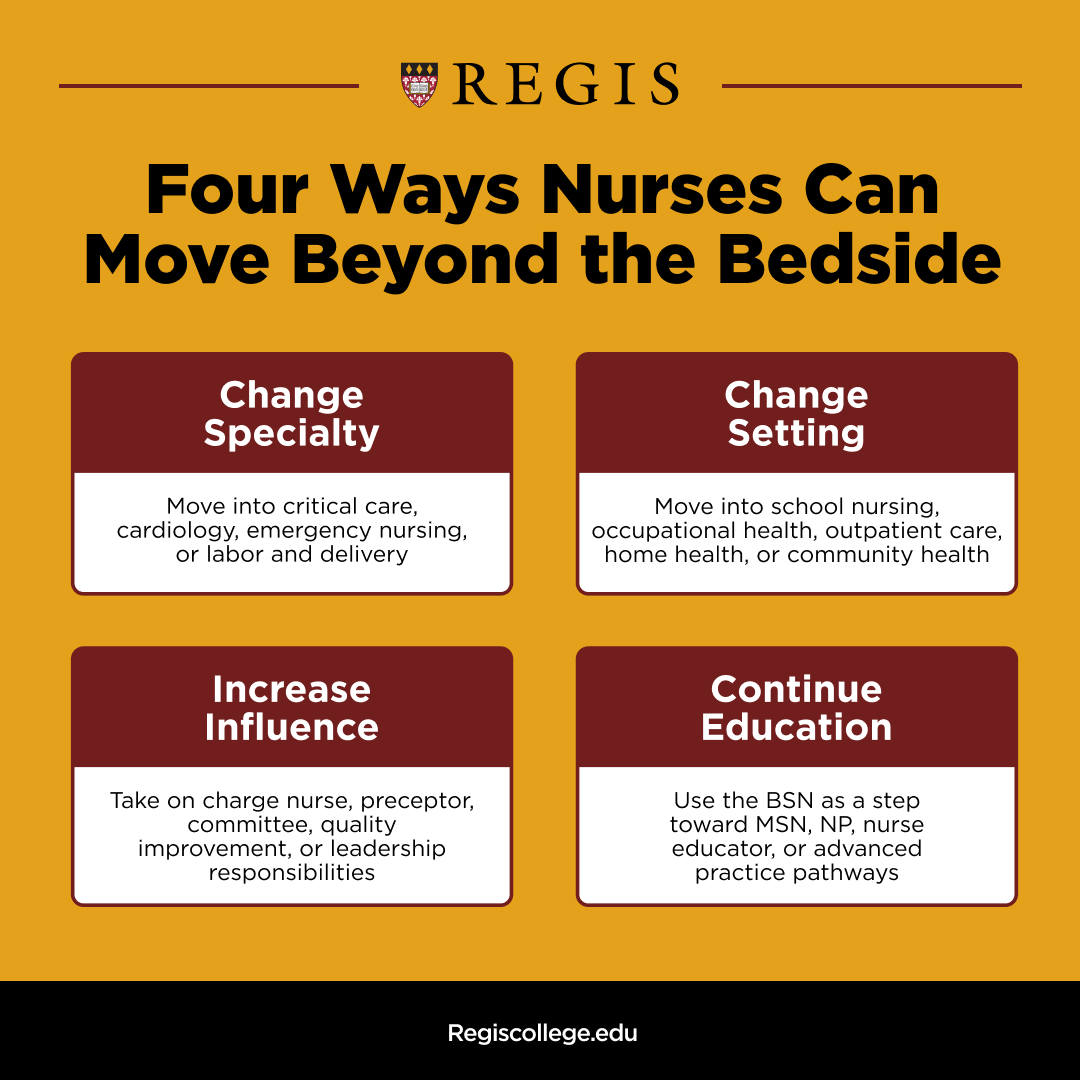
You may be able to pursue roles in leadership, school nursing, occupational health, community health, public health, care coordination, quality improvement, specialty practice, patient education, graduate nursing, and nontraditional nursing paths. Some roles may require more than a BSN alone, but the degree can help create the foundation for long-term mobility.
The most important value may be flexibility.
A BSN can help you prepare for the version of nursing you want now and the version you may need later. It can support nurses who want to stay clinical, move into a specialty, change settings, lead teams, teach patients, improve systems, or continue toward graduate study.
As Roy puts it, “Everybody needs a nurse.”
The question is not whether bedside nursing matters. It does. The question is whether you want more options across the full span of your nursing career.
If you’re ready to see if attaining your BSN is the right next step for you, we encourage you to explore Regis College’s BS in Nursing RN-to-BS Degree Completion program. Want to know more? Request information and get answers to your questions.

Published Date