
If you are already a registered nurse, you are not starting from scratch. You have completed nursing coursework, passed the NCLEX-RN, earned your license, and built clinical experience in real healthcare settings.
So when you begin comparing programs to complete your bachelor’s degree, one of the most practical questions you can ask is: What will I actually learn?
RN to BSN programs build on the clinical foundations you developed through your associate's degree and professional nursing experience. Students don’t just repeat bedside skills. Instead, BSN-level coursework expands your perspective into areas such as evidence-based practice, leadership, population health, healthcare policy, ethics, informatics, quality improvement, health assessment, and systems-level problem-solving.
At Regis College, the BS in Nursing RN-to-BS Degree Completion program is designed for registered nurses with an associate's degree who want to continue their education while balancing work and life responsibilities. Understanding how such a program can expand your knowledge base while strengthening existing skills is essential when determining whether furthering your education will open new career opportunities that fit your goals.
Key Takeaways
- RN-to-BS coursework builds on your existing clinical experience rather than replacing what you learned in an associate's degree program.
- BSN-level courses often focus on leadership, evidence-based practice, health assessment, population health, policy, informatics, ethics, and quality improvement.
- Leadership in nursing is not limited to management; advocacy, communication, conflict resolution, and problem-solving are also leadership behaviors.
- A capstone project can help you apply evidence, leadership, ethics, policy, and stakeholder thinking to a real nursing problem.
- Regis’s RN-to-BS curriculum is designed for working nurses and includes 30 credits of required nursing coursework.
How Is RN-to-BS Coursework Different From an Associate's Degree in Nursing?
Associate's degree nursing programs play an essential role in preparing professionals for entry into practice. They help students build the knowledge and clinical competencies needed to care for patients, pass licensure exams, and begin working as registered nurses.
But BSN-level coursework has a different purpose. It builds on direct patient care preparation and helps nurses think more broadly about healthcare systems, evidence, leadership, population needs, policy, quality improvement, and professional influence.
Deborah Roy, MSN, DNP, RN to BS Degree Completion program director at Regis College, explains the distinction this way: “The ASN program is really geared for the competencies of the tactile, kinetic activities that you’re going to be doing as a nurse. So there’s a lot of anatomy and physiology and pharmacology and pathophysiology and translating that knowledge into care practices.”
“The BSN component of the nursing degree dives a lot more into policy,” Roy continues. “What are the politics surrounding healthcare? What are the public health needs, and how do we start influencing public health? How do we put together a plan to address issues that might be on a unit or in an organization, in a community, or they might be nationwide?”
Such a shift is not from “clinical” to “non-clinical.” It is from asking only, “How do I care for this patient today?” to also asking:
- What evidence supports this approach to care?
- What system factors are affecting this patient’s outcome?
- How does communication on the team influence safety?
- What health needs exist beyond this patient assignment?
- What change could improve care in my unit or in my community?
- How can nurses influence practice, policy, and patient outcomes?
For working nurses, that broader perspective—connecting what you already do day-in, day-out to the larger professional, organization, and community context of healthcare—can be incredibly beneficial to a career path.
Why Is Evidence-Based Practice a Core Part of RN-to-BS Coursework?
Evidence-based practice is one of the clearest examples of how RN-to-BS coursework builds on clinical experience.
As a working nurse, you may already notice recurring problems. Maybe a process on your unit feels inefficient. Perhaps you notice that patients are not receiving consistent discharge education. Specific documentation workflows may be creating confusion.
For RN-to-BS students, evidence-based practice can support:
- Better clinical decision-making
- Stronger patient advocacy
- Quality improvement efforts
- Safer care processes
- More effective patient education
- Stronger preparation for graduate study
- Greater confidence in interdisciplinary conversations
That focus on such skill sets is seen within the industry as a whole. The American Association of Colleges of Nursing Essentials", for instance, outlines necessary curriculum content and expected competencies for graduates of baccalaureate, master’s, and Doctor of Nursing Practice programs—using informatics and healthcare technologies to support safe, high-quality care—connecting what graduates are asked to learn directly to real professional practice.
Evidence-based practice gives nurses a structured way to ask: What do we know about this problem, and what does the evidence suggest we should do?
How Do RN-to-BS Programs Build Leadership Skills?
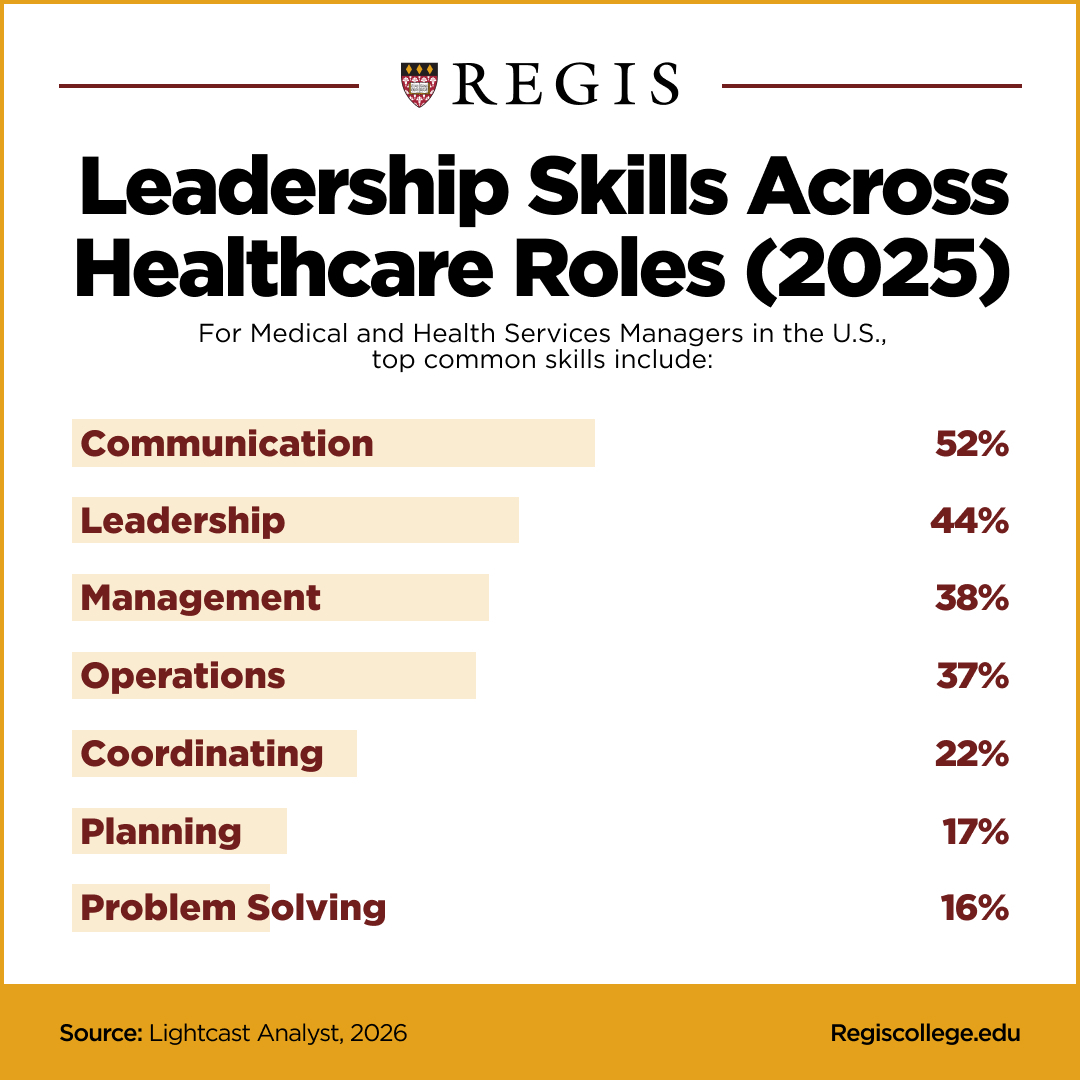
Leadership is not separate from nursing practice. It is embedded in the way nurses communicate, advocate, teach, respond to conflict, and influence care.
Roy says that nurses often underestimate the leadership they already demonstrate. That is why the Regis program emphasizes leadership even for students who do not plan to become managers.
“They have influence not only on their patients but their unit environment, the organization, and nursing profession as a whole,” says Roy. “The behaviors that they exhibit day to day, the things that they’re advocating for, those are leadership behaviors.”
A nurse who sees leadership as not just a title but as a part of advocacy, communication, problem-solving, and professional accountability may begin to see new ways to contribute.
For example, leadership coursework can help nurses think through questions such as:
- How do I communicate with a defensive colleague?
- How do I address incivility in my unit?
- How do I advocate for a patient when a plan of care is unclear?
- How do I bring evidence to a conversation about changing practice?
- How do I identify the stakeholders who need to support an improvement?
- How do I help create a safer or more supportive team culture?
“Those same skills are applicable at the bedside,” says Roy. “Those same skills are applicable wherever they want to go in nursing, even if it’s not moving into formal leadership positions.”
What Will You Learn About Population Health and Healthcare Systems?
Nurses often begin their careers focused on the immediate and essential needs of individual patients. But BSN-level coursework also asks nurses to think about the health of communities, populations, and systems.
Population health coursework may explore how factors such as income, education, housing, access to care, chronic disease, environment, culture, and public policy affect health outcomes.
Looking at issues through such a lens can help nurses understand why some patients return to the hospital repeatedly, or why certain communities face higher rates of chronic illness.
It also supports career mobility. Nurses who understand population health may be better prepared for roles in:
- Community health
- Public health
- School nursing
- Occupational health
- Case management
- Care coordination
- Patient education
- Quality improvement
- Healthcare leadership
The U.S. Bureau of Labor Statistics notes that registered nurses work in a wide range of settings, including hospitals, physicians’ offices, home healthcare services, nursing care facilities, outpatient clinics, and schools. That variety is one reason a broader understanding of healthcare systems can be valuable across a nursing career.
Why Does RN-to-BS Coursework Matter in a Changing Healthcare Environment?
Healthcare is changing quickly. Nurses are working with electronic health records, telehealth platforms, data dashboards, documentation tools, and artificial intelligence-supported systems. They are also caring for complex patient populations while navigating staffing challenges, changing regulations, and new models of care.
That means nurses increasingly need to be adaptable, exercise judgment, excel in communication, and have the ability to evaluate information critically.
The emergence of artificial intelligence and “big data” are other factors nurses must consider when establishing their knowledge foundation.
“We’re going to have to deal with big data. We’re going to have to deal with artificial intelligence,” Roy says. “But we can’t trust it implicitly, right? Bad data in, you get bad data out. If you’re asking a bad question, you’re going to get bad answers.”
Nurses need “a strong foundation in science,” Roy insists, to interact with such advanced tools “in a manner that’s actually going to be beneficial and safe.”
RN-to-BS coursework can support that kind of professional judgment by emphasizing evidence, informatics, policy, ethics, leadership, health assessment, and systems thinking.
O*NET’s Registered Nurses profile identifies skills such as active listening, social perceptiveness, coordination, critical thinking, and service orientation as important for RNs. Those skills become even more important as healthcare grows more complex and technology becomes more embedded in care delivery.
In a changing healthcare environment, nurses need to know how to interpret information, ask better questions, advocate for patients, and adapt when conditions change.
How Is Regis’s RN-to-BS Program Designed for Working Nurses?
Many RN-to-BS students are not traditional undergraduates. They are working nurses with shifts, families, bills, and professional responsibilities. That makes flexibility and support essential.
Regis’s RN-to-BS program is designed specifically for registered nurses who already have an associate's degree and are hoping to continue their education for professional and personal growth.
The program can be completed in as little as 12 months, and students can transfer in up to 90 credits. Regis also awards 45 credits for associate's degree nursing coursework and an active RN license.
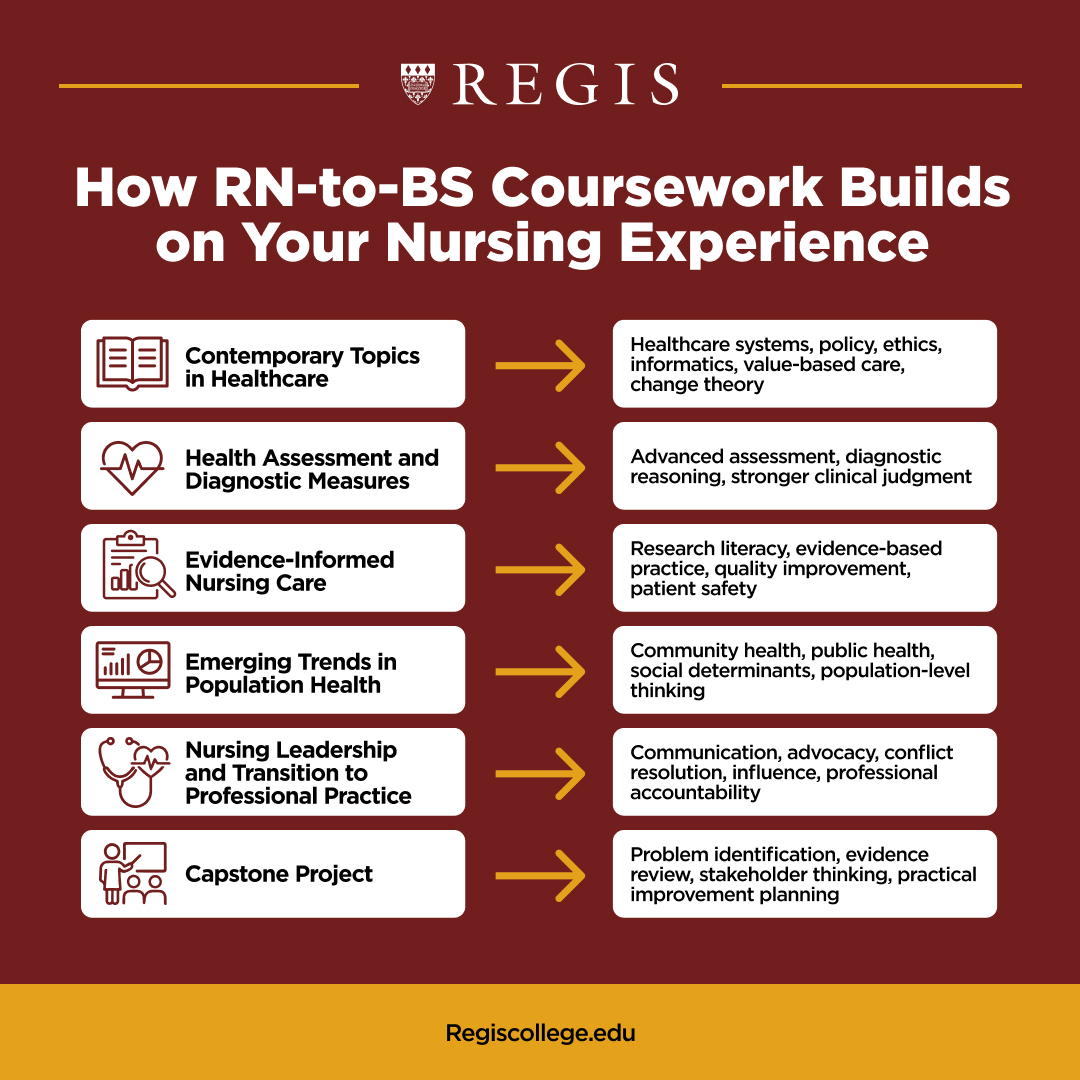
The program’s required nursing curriculum totals 30 credits and is offered in an online format designed with working nurses in mind. Students focus on areas such as evidence-informed nursing care, where students learn to evaluate research and apply it to real-world practice; population health, which explores how social and environmental factors influence patient outcomes; and nursing leadership, which focuses on communication, advocacy, and problem-solving within healthcare teams.
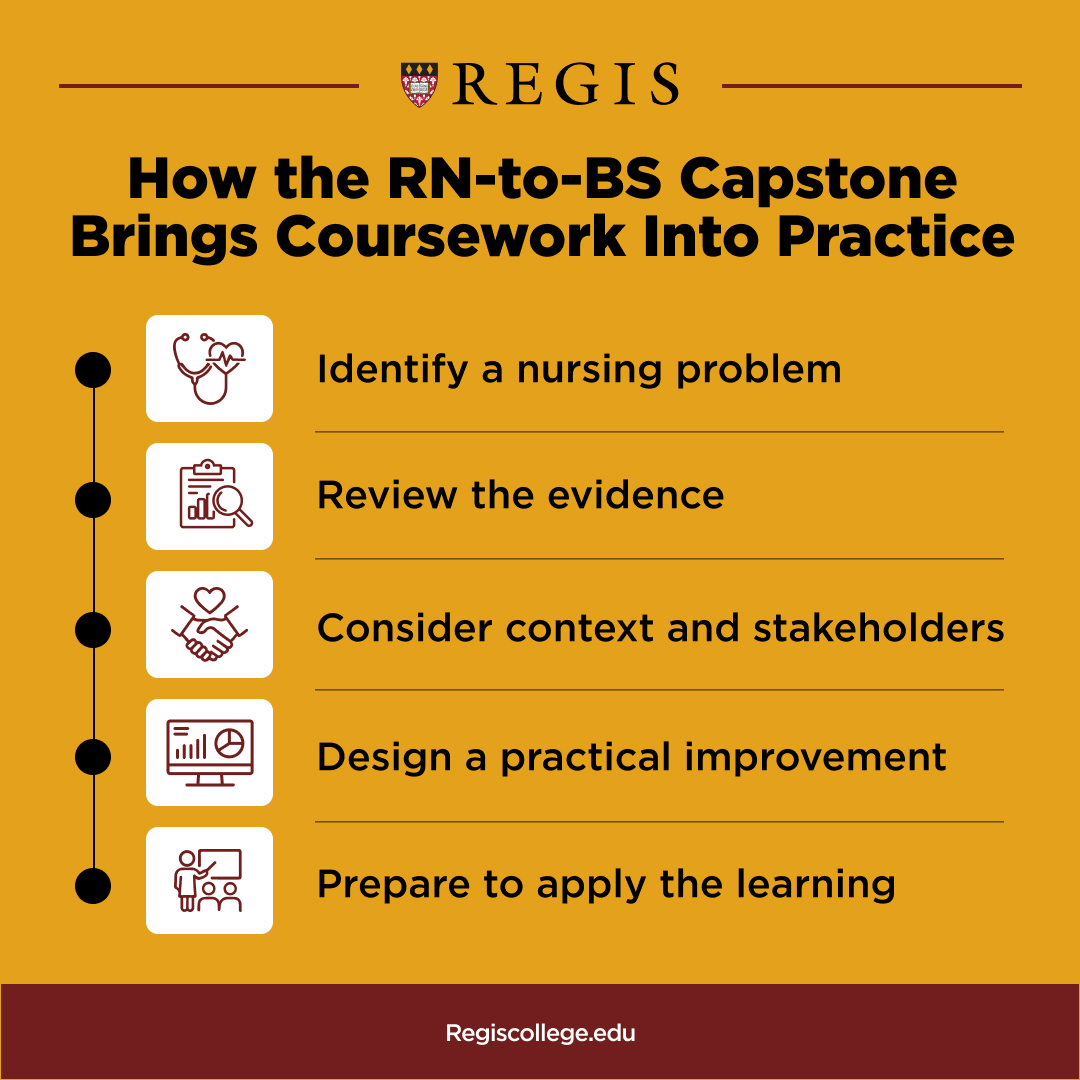
Students also complete advanced health assessment coursework and a capstone project that allows them to apply what they have learned to a practical issue in their own work environment.
“The curriculum for the RN-to-BS program is very practically centered,” Roy explains. “It does have theory and research, but we’re utilizing it in a way that they’re going to be able to utilize it every single day in their work environment to help them navigate and meet their goals.”
That practical focus can matter for students who are worried the coursework will feel disconnected from their real responsibilities.
Roy points out that assignments, especially in leadership coursework, often ask students to connect concepts directly to their own jobs or the organizations for whom they work. Instead of studying concepts in the abstract, faculty often ask students to consider what is happening in their current work environment and apply what they have learned to a real issue.
Faculty and staff also offer personalized assistance and bring their own industry background and real-world experience to the courses. And for those accepted into the program, a personalized curriculum plan is established, giving you a timeline for completion.
For nurses comparing programs, the promise of such support is important. The flexibility of online learning can, for many, be a requirement, but students still need access to faculty and advisors who understand the realities of working while going to school.
How Can RN-to-BS Coursework Affect Your Career?
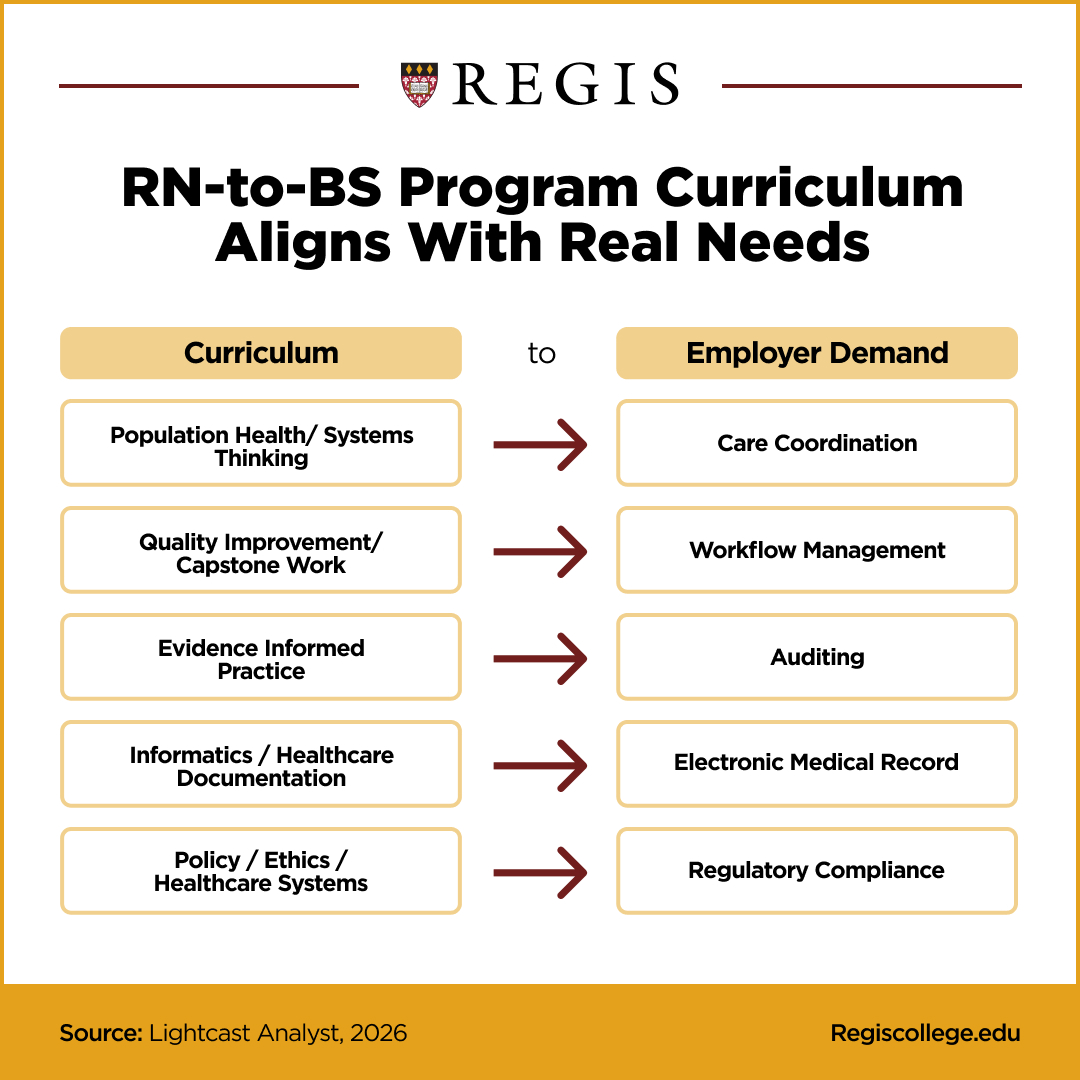
The career impact of RN-to-BS coursework is not limited to a single job title. Instead, the curriculum is designed to broaden what nurses are prepared to do over time.
A BSN may help nurses become more competitive for specialty practice, leadership responsibilities, school nursing, occupational health, community health, public health, care coordination, quality improvement, graduate study, and other professional opportunities.
For nurses considering graduate education, the RN-to-BS can also serve as a step toward advanced nursing pathways. Regis’ program offers a direct pathway to its Master’s in Nursing (MSN) program for those who want to continue toward master’s-level nursing preparation.
Still, the career value of the coursework is not only about leaving the bedside.
The same skills that support career mobility can also make someone a stronger bedside nurse. Evidence-based practice, communication, assessment, emotional intelligence, leadership, and systems thinking all matter in direct patient care.
Roy emphasizes that nursing can be a lifelong profession with many possible directions.
“There’s always options for everyone in healthcare,” she says. “And particularly in nursing, everybody needs a nurse.”
RN-to-BS Curriculum Builds on What You Already Know
An RN-to-BS curriculum is designed to build on your existing clinical foundation and expand your ability to lead, use evidence, understand healthcare systems, improve care, and prepare for long-term career growth.
It is not simply a repeat of your associate's degree. It is a broader professional education that helps you connect bedside experience to leadership, research, policy, population health, informatics, ethics, and practical change.
For working nurses, that matters. The value of the curriculum is not just in earning credits. It is in learning how to think more broadly, act with greater influence, and adapt in a healthcare environment that continues to change.
Regis’ program is designed to help registered nurses take that next step through flexible online coursework, practical assignments, faculty support, and a curriculum focused on real nursing practice.
To learn more, explore Regis College’s RN-to-BS Degree Completion program, review the curriculum and admission requirements, or download the RN-to-BS program flyer.

Published Date