
Licensure, Career Outcomes and Job Demand
Considering whether or not to pursue a master’s in counseling involves more than just weighing the cost of tuition. Long-term career stability, professional credibility, and whether the work itself will feel meaningful enough to justify the investment are all questions that need answers when making such an important decision.
So, is a master’s in counseling worth it?
For many aspiring mental health professionals, the answer is yes. A master’s degree, like the one offered by Regis College, is typically required for licensure, opens access to a wide range of clinical roles, and positions graduates in a field with strong projected job growth. The real value of the degree comes down to three core factors:
- Growing demand for licensed counselors
- Licensure as a gateway to autonomy and advancement
- Career flexibility across multiple settings
Here, we’ll explore how a master’s-level education helps prepare graduates to enter an in-demand field and take advantage of the numerous options and opportunities a counseling career has to offer.
Key Takeaways
- A master’s in counseling is typically required for licensure and independent clinical practice in most states.
- Job demand for mental health counselors is projected to grow 17% from 2024 to 2034, much faster than average.
- Licensure unlocks professional autonomy, higher reimbursement potential, and expanded career options for counseling professionals.
- The MA in Counseling program at Regis College aligns with licensure standards, reports strong exam pass and employment outcomes, and prepares graduates for long-term career sustainability.
Is Job Demand Strong for Mental Health Counselors?
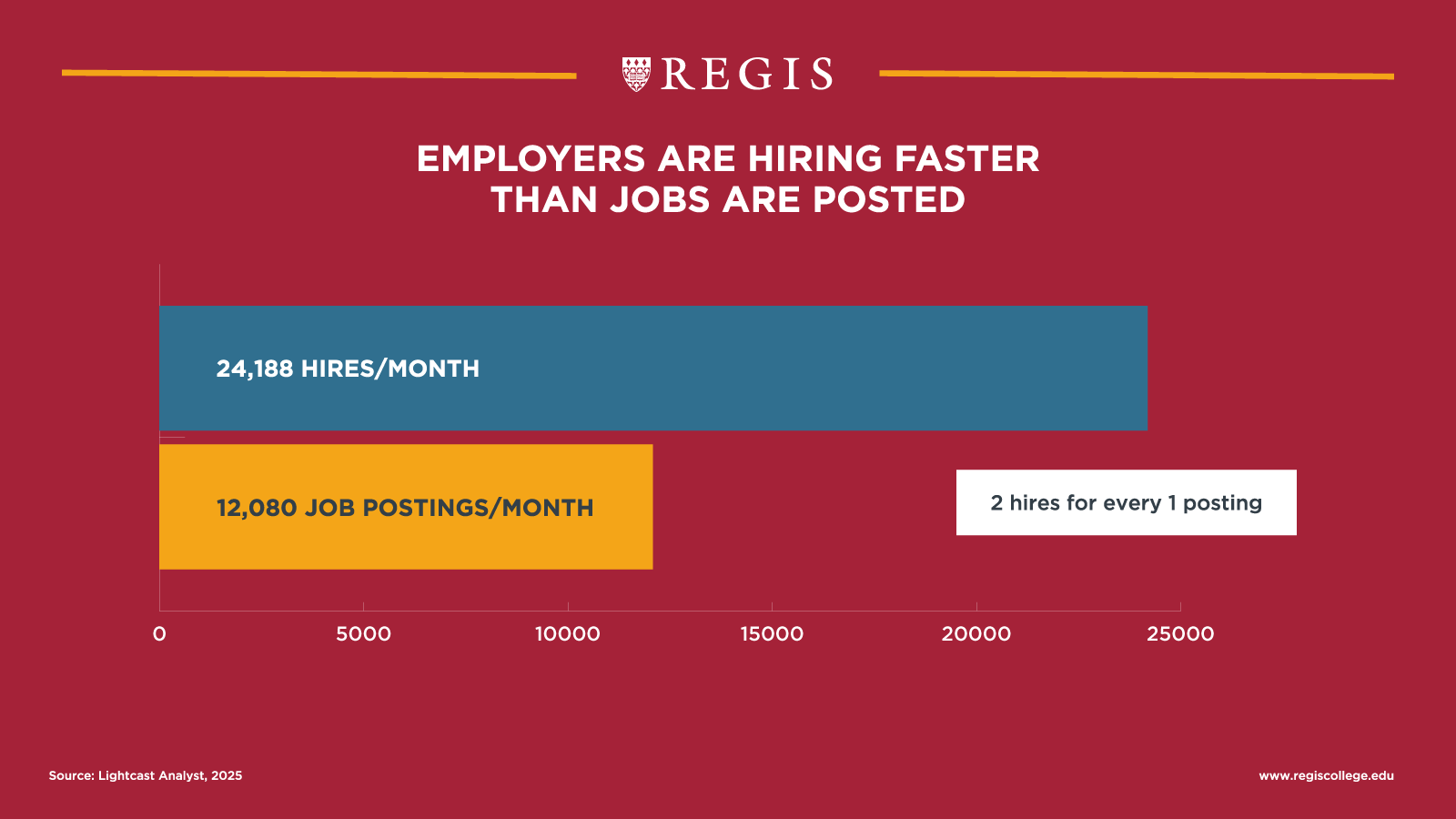
One of the clearest indicators of a degree’s value is whether it leads to real, sustained employment opportunities.
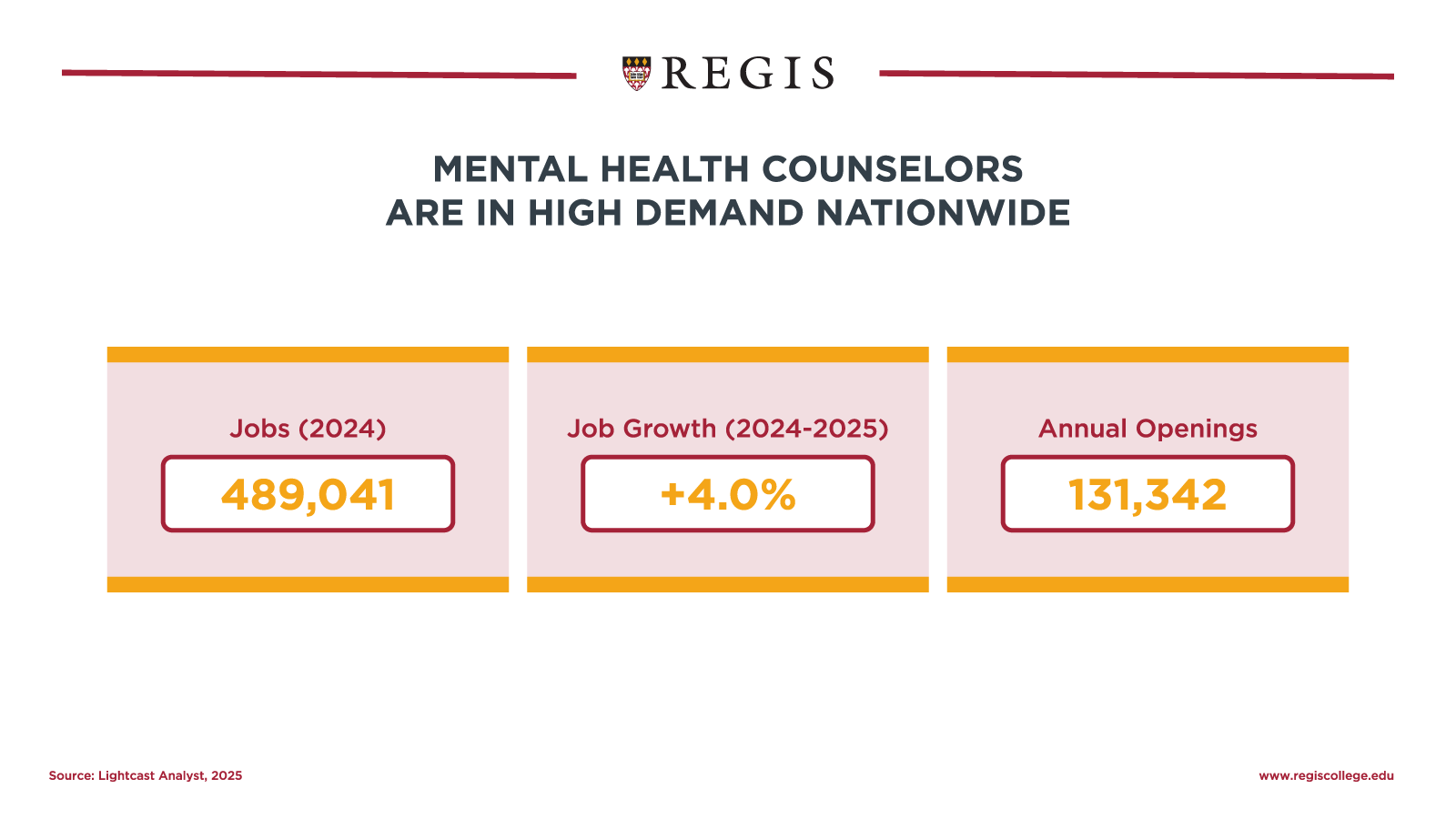
According to the U.S. Bureau of Labor Statistics, employment of substance abuse, behavioral disorder, and mental health counselors is projected to grow 17% from 2024 to 2034, much faster than the average for all occupations. Median pay in May 2024 was $59,190 per year, with approximately 483,500 jobs nationwide in 2024 alone.
Related counseling professions show similar strength:
- Marriage and Family Therapists: Median pay of $63,780 (2024), with 13% projected growth
- School and Career Counselors and Advisors: Median pay of $65,140 (2024), with approximately 31,000 projected openings per year
These numbers reflect a sustained national need for mental health professionals across outpatient centers, hospitals, residential facilities, schools, and private practice settings. As Brandon Jones, PhD, interim director of graduate counseling programs at Regis College, explains, “There’s going to be a place for you. If all you want to do is work as a counselor, there will be jobs.”
That statement aligns with what many programs are seeing in practice and what the labor data is saying. Graduates who complete licensure-aligned programs and enter the workforce are finding that many opportunities exist.
Ready To Start A Career In Counseling?
Download our guide to learn everything you need to know!

Do You Need a Master’s Degree to Become a Licensed Counselor?
In most states, the answer is yes.
To become a Licensed Mental Health Counselor (LMHC) or Licensed Professional Counselor (LPC), candidates must typically complete:
- A 60-credit master’s degree in counseling or a closely related field
- A supervised practicum and internship
- A national licensing exam (such as the NCMHCE)
- Post-master’s supervised clinical hours
For example, Massachusetts requires a 60-credit degree for LMHC eligibility, which aligns with licensure expectations in most states. Some programs nationally are still structured as 48-credit degrees, which may require additional coursework before licensure eligibility.
At Regis College, the MA in Counseling program is specifically designed to support LMHC/LPC licensure pathways. Requiring 60 credits, the curriculum includes coursework in counseling theory, multicultural foundations, ethics, psychopathology, diagnostic assessment, group counseling, research, addictions, psychopharmacology, and built-in practicum and internship experiences.
Licensure matters because it changes what you’re legally and professionally allowed to do. As Jones explains, “Licensure is going to be the thing that helps you do that… Licensure also unlocks higher reimbursement rates… and licensure is the thing that lets people hang a shingle if they want to.”
The degree itself is important, and the opportunity it unlocks—licensure—is what allows for professional independence. It enables:
- Clinical practice
- Insurance reimbursement
- Supervisory roles
- Private practice ownership
- Greater career mobility across settings
If your long-term goal includes autonomy, advancement, or specialized clinical work, a licensure-aligned master’s degree is essential.
What Jobs Can You Get With a Master’s in Counseling?
A master’s in counseling can lead to roles across a range of clinical and institutional environments.
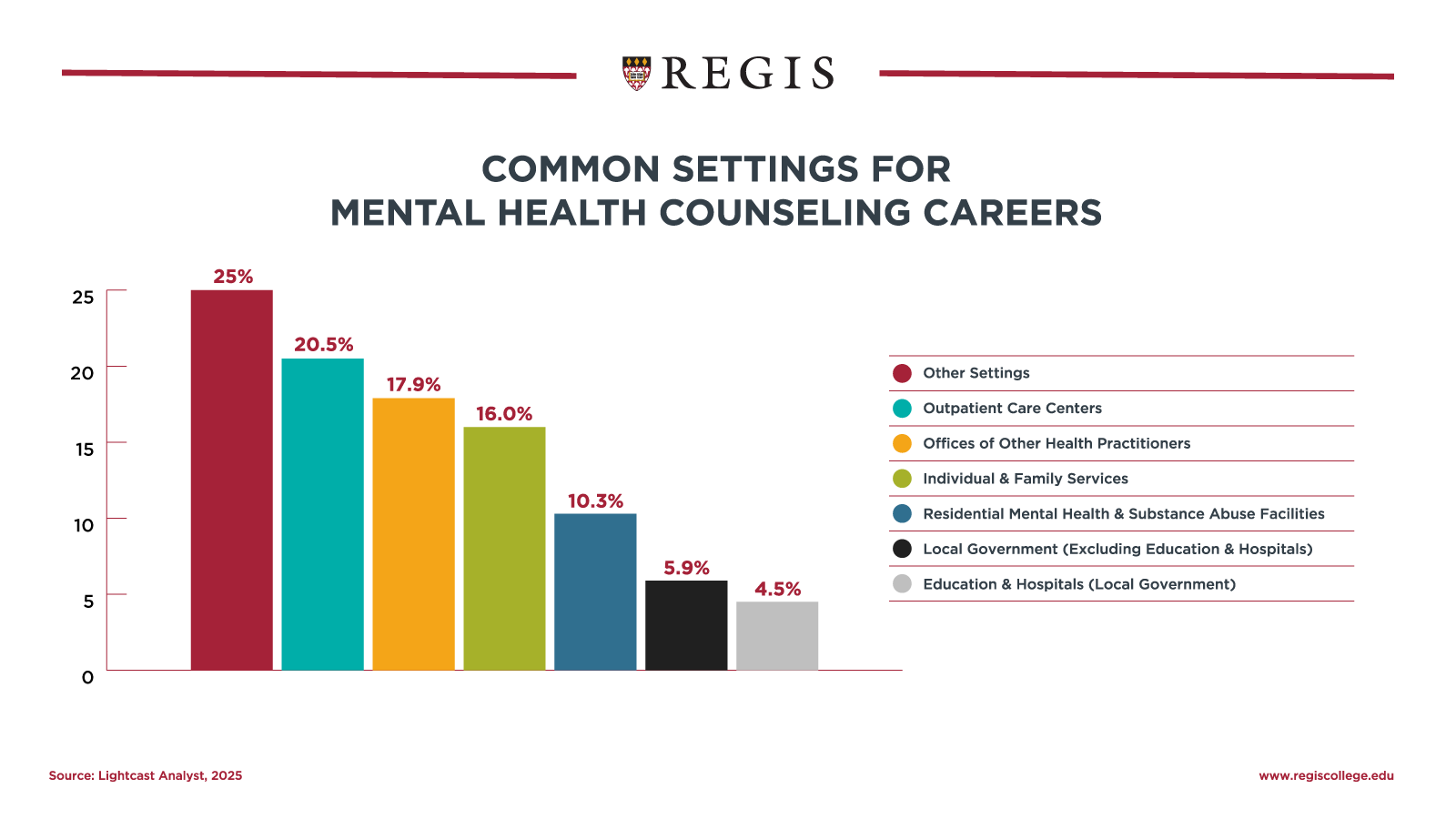
Graduates commonly work in:
- Community mental health centers
- Hospitals and acute care settings
- Substance use treatment programs
- Trauma-focused practices
- Schools and universities
- Private practice
- Integrated healthcare teams
The Regis College MA in Counseling program positions graduates to work across these settings, and Regis reports a 100% employment rate for graduates who entered the workforce upon completion of the program.
Some students pursue specialized tracks, such as addictions counseling, which may align with additional licensure pathways depending on fieldwork and exam requirements. Others use the degree as a stepping stone toward doctoral study.
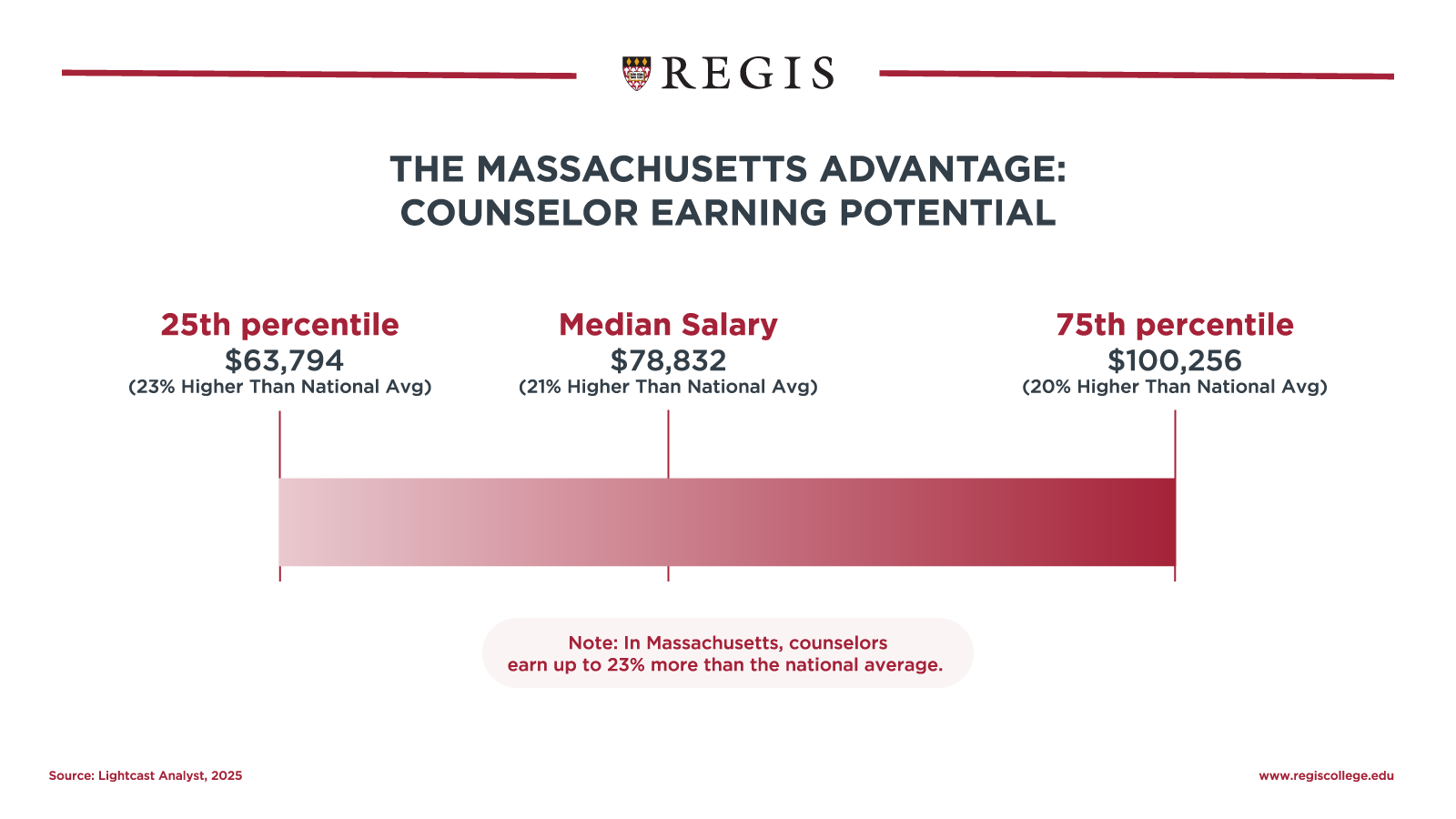
Counseling as a profession provides opportunities for adaptability. Whether your interests lean toward trauma work, family systems, addiction recovery, school counseling, or integrated behavioral health, the foundational training supports multiple trajectories, as well as ample opportunity to earn a competitive salary, especially for those who remain in the Massachusetts area.
Beyond Salary: What Makes the Degree “Worth It”?
Salary and job outlook aren’t the only measure of return on investment.
For many students, counseling begins with a desire to help. The master’s degree provides the structure, clinical skills, and ethical framework necessary to do that work responsibly and effectively.
Programs grounded in experiential learning and close faculty mentorship can significantly shape how prepared graduates feel entering the field. At Regis College, for example, courses emphasize clinical simulations and applied learning, with small class sizes designed to provide individualized feedback and skill development.
The program also reports a 100% pass rate on the National Clinical Mental Health Counseling Examination (NCMHCE), a key milestone on the path to licensure.
Those outcomes speak to preparation. Jones, for instance, often sees a shift in students during their coursework. “At some point something clicks,” he says. “...They stop thinking about, ‘How do I become a counselor?’ and start asking, ‘How can I do counseling as myself?’”
That evolution—from learning techniques to developing a professional identity—may not be as easy to quantify as are salary statistics, but it’s often what makes them attractive candidates upon entering an expanding workforce and sustains counselors through long careers.
Is a Master’s in Counseling Worth It for You?
The answer depends on your goals.
A master’s in counseling is likely worth it if you:
- Want to become a licensed mental health professional
- Seek a career with projected growth and national demand
- Value meaningful, client-centered work
- Want the option to pursue private practice or leadership roles
- Are prepared to complete supervised clinical training
For those who aspire to such goals, the MA in Counseling at Regis College is intentionally structured to support you. With an emphasis on experiential learning— incorporating clinical simulations and applied training into coursework so students build confidence before entering field placements—and smaller class sizes, students receive individualized feedback and mentorship throughout their development.
Ready to take the next step? If you’d like to learn more about the program sign up for an information session, where a member of our admissions team and faculty or program director, can answer any questions you might have.




Published Date