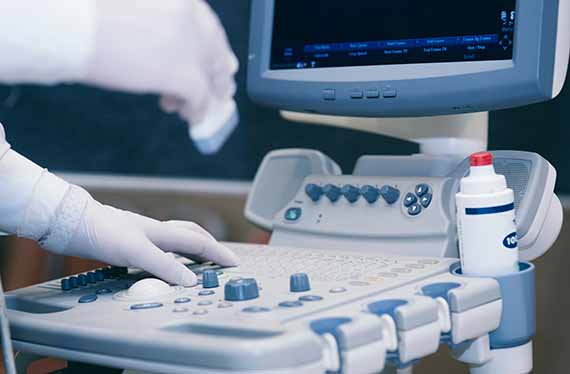
The following standards serve as technical requirements for students enrolled in the Diagnostic Medical Sonography Program. These standards reflect the reasonable expectations of students in performing the common functions of both a Diagnostic Medical Sonography student and a practicing sonographer.
Students must demonstrate the ability to apply knowledge and skills necessary to function effectively in a wide range of academic and clinical settings.
Applicants and enrolled students are required to review the Society of Diagnostic Medical Sonography’s publication, Work-Related Musculoskeletal Disorders and Sonography.
Every student in the sonography program must possess the ability to learn and perform the following technical requirements:
Motor Skills
The student possesses sufficient motor capabilities to execute the movements and skills required to provide sonography. These include, but are not limited to:
- Ability to perform hand and upper extremity repetitive movements and sustained positions, for extended periods of time, which requires fine and gross motor skills for both hands, and upper extremities.
- Ability to adjust, position, and move patients and equipment. This involves carrying, bending, kneeling, twisting, stooping, lifting, crouching, pushing, pulling, and reaching (including overhead). Ability to routinely lift, move, and transport patients between wheelchair to exam bed, and stretcher to exam bed.
- Possess physical strength and endurance to sit and stand for long periods of time.
- Possess physical strength and endurance including the ability to carry equipment and supplies, and transfer and transport patients.
- Fine motor skills including the ability to pinch and pick-up objects with both hands, grasp small objects with hands and fingers, twist with hands, write with pen or pencil, and use electronic equipment.
- Ability to lift 50 pounds.
- Ambulate independently for clinical practice.
- Ability to administer CPR without assistance.
- Possess the endurance to complete all required tasks during the assigned period of clinical practice.
- Ability to respond immediately with coordination, speed, balance and agility to patient emergencies.
- Ability to perform physical tasks and practice correct ergonomics as indicated by the Society of Diagnostic Medical Sonography, OSHA, the CDC, and the Joint Commission (JCAHO). More information and links.
Sensory Skills
The student possesses the ability to obtain information in classroom or clinical settings through observations and other measures, including but not limited to:
- Visual ability (corrected as necessary) to focus for extended periods of time, use depth perception, use peripheral vision, differentiate subtle shades of gray, distinguish color changes and intensity for Doppler sonography and patient care, see slight differences in shapes and objects, read or set parameters on equipment, and distinguish letters in 12-point font at both near and far distances.
- Visual ability (corrected as necessary) to recognize and interpret facial expressions and body language, and to identify normal and abnormal patterns of movement.
- Auditory ability to recognize and respond to soft voices, faint body sounds, auditory timers, equipment alarms, call bells, and to effectively use devices for measurement of blood pressure and Doppler sonography.
- Ability to demonstrate hand-eye coordination for sonography scanning requiring fine and gross motor skills.
- Tactile ability to palpate a pulse, temperature, vibration, and to detect changes or abnormalities of surface texture, palpable masses, skin temperature, body contour, muscle tone, and joint movement.
- Olfactory ability to detect smoke and other odors.
- Sufficient position, movement, and balance sensations to assist and safely guard (protect) patients who are ambulating, transferring, or performing other activities.
Communication Skills
The student utilizes effective communication with peers, faculty, and other health care providers. Communication competencies include knowledge, attitude, and skills necessary to provide quality and safe patient care in all healthcare settings. This includes, but is not limited to:
- Able to read, write, speak, and understand English at a level consistent with successful course completion and patient safety.
- Establish professional relationships with peers, faculty, patients, and health care providers.
- Ability to read at a competency level that allows one to carry out the essential functions of an assignment and patient documents (examples: handwritten data, printed policy, procedure manuals, and all things pertaining to a patient medical record).
- Ability to effectively interpret and process information.
- Ability to establish a therapeutic rapport with patients.
- Ability to obtain a medical history, explain the exam to the patient, and explain sonographic findings effectively and professionally to appropriate medical staff.
- Ability to effectively and efficiently communicate (verbally and in writing) with faculty, patients, families, and health care professionals in English.
- Accurately elicit information from patients, family members, and healthcare personnel, related to a patient’s medical history and current status necessary to adequately and effectively evaluate a patient’s condition.
- Ability to access information, as well as effectively communicating and documenting when necessary, using computers, PACS, and electronic medical records.
- Ability to recognize, interpret, and respond to nonverbal behavior of self and others.
Behavior Skills
The student has to be able to exercise good judgment and tolerate contact with a diverse population, including people of all ages, races, socioeconomic and ethnic backgrounds, and medical or mental health problems. This also includes, but is not limited to:
- Ability to work with multiple patients and colleagues at the same time.
- Ability to work with peers, instructors, health care providers, and patients under stressful conditions, including but not limited to providing care to medically or emotionally unstable individuals, situations requiring rapid adaptations, the provision of CPR, or other emergency interventions.
- Ability to foster and maintain cooperative and collegial relationships with peers, instructors, other health care providers, and patients.
- Express feelings and ideas in a professional manner.
- Provide and accept feedback respectfully and professionally.
- Provide safe and competent patient care.
Critical Thinking and Cognitive Skills
The student possesses sufficient abilities in the areas of calculation, critical problem solving, reasoning, and judgment to be able to comprehend and process information within a reasonable time frame as determined by the faculty and the profession. The student must be able to prioritize, organize, and attend to tasks and responsibilities efficiently. This includes, but is not limited to:
- Participate in intellectual activities requiring critical thinking, judgment, and analysis.
- Ability to measure, collect, interpret, and analyze written, verbal, and observed data about patients.
- Ability to demonstrate arithmetic competency, including mental math, in the classroom and clinical setting including emergency patient care situations.
- Ability to prioritize multiple tasks, integrate information, and make decisions in a prompt and timely fashion.
- Ability to apply the principles, indications, and contradictions for sonography.
- Ability to interpret sonographic findings in relation to imaging factors, image quality, and anatomical orientation.
- Ability to conceptually visualize anatomy and pathology in three dimensions.